Showing posts with label Index of Refraction. Show all posts

Optics - Index of Refraction

A light source is at the bottom of a pool of water (the index of refraction of water is 1.33). At what minimum angle of incidence will a ray be totally reflected at the surface?

A. 0 
B. 25o
C. 50
D. 75o
E. 90
(GR9677 #56)
Solution:

Snell's Law: nw sin θi na sin θr


For total internal reflection, θr = 90o
nsin θi  =  na
sin θi na/nw 1/1.33 ≈ 3/4
Convert to degree, θ = ¾ × 180/π ≈ 45o closer to 50

Answer: C

Optics - Thin Film

A soap film with index of refraction greater than air is formed on a circular wire frame that is held in a vertical plane. The film is viewed by reflected light from a white-light source. Bands of color are observed at the lower parts of the soap film, but the area near the top appears black. A correct explanation for this phenomenon would involve which of the following?

I. The top of the soap film absorbs all the light incident on it; none is transmitted.

II. The thickness of the top part of the soap film has become much less than a wavelength of visible light.

III. There a phase change of 180o for all wave-lengths of light reflected from the front surface of the soap film.

IV. There is no phase change for any wavelength of light reflected from the back surface of the soap film

A. I only
B. II and III only
C. III and IV only
D. I, II and III
E. II, III and IV
(GR9277 #21)
Solution:


I. FALSE. 
Soap film does not absorb light.

II. TRUE.
The gravity effect on water molecules decreases the thickness, t of the top of the soap film, become much less than a wavelength, λ of visible light.

When t ≪ λ, the path difference between the front and the rear surface reflections is small compared to λ. It causes an insignificant phase shift. The result is complete destructive interference of the 2 light waves, creating a black band.

III and IV. TRUE.

Thin film: 
n1〈  n→ there is 180phase change
nn→ no phase change 
n = refractive index

From air to soap (front surface):
nair〈  nsoap → 180phase change

From soap to air (back surface):
nsoap nair → no phase change 


Answer: E

Optics - Index of Refraction

A fast charged particle passes perpendicularly through a thin glass sheet of index of refraction 1.5. The particle emits light in the glass. The minimum speed of particle is 

A.  1/3 c
B.  4/9 c
C. 5/9 c
D. 2/3 c
E. c
(GR9277 #69)
Solution:

Index of refraction, nc/v
n = 1.5 = 3/2
v = c/n = 2/3 c

Answer: D

Special Relativity - Index of Refraction

The measured index of refraction of X-rays in rock salt is less than one. This is consistent with the theory of relativity because

A. Relativity deals with light waves traveling in a vacuum only
B. X-rays cannot transmit signal
C. X-rays photons have imaginary mass
D. The theory of relativity predates the development of solid-state physics
E. The phase velocity and group velocity are different
(GR8677 #72)
Solution:

Index of refraction, n = c/v

For X-rays,  1 → v  c (violates the theory of special relativity)
However, this is OK, because in this case, v is phase velocity, vp.

vdoes not represent the particle velocity.
The physical speed of particle is represented by group velocity, vg.

Answer: E

Optics - Thin Film

It is necessary to coat a glass lens with a non-reflecting layer. If the wavelength of the light in the coating is λ, the best choice is a layer of material having an index of refraction between those of glass and air and a thickness of

A. λ/4
B. λ/2
C. λ/√2
D. λ
E. 1.5λ
(GR8677 #73)
Solution:
Index of refraction: 

Air to Layer,
phase difference: Δa = λ/2

Layer to Glass,
phase difference: Δb = 2t + λ/2

The relative shift: Δ = Δb − Δa =  2t + λ/2 − λ/2 = 2t

Non-reflecting → destructive interference
Δ = (m +½)λ

m = 0 (the thinnest the better)
2t = (0 +½)λ
t = λ/4

Answer: A


Notes: Click HERE for more info on Thin Film.

Optics - Thin Film

Blue light of wavelength 480 nanometers is most strongly reflected off a thin film of oil on a glass slide when viewed near normal incidence. Assuming that the index of refraction of the oil is 1.2 and that of the glass is 1.6, what is the minimum thickness of the oil film (other than zero)?

A. 150 nm
B. 200 nm
C. 300 nm
D. 400 nm
E. 480 nm
(GR0177 #69)
Solution:

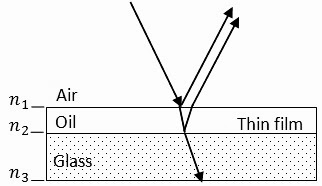
n= 1
n= 1.2
n= 1.6

n n→ Δa λ/2
n n→ Δb = 2tλ/2

The Relative Shift:
Δ = Δb − Δa = 2t + λ/2 − λ/2 = 2t

For Constructive Interference: Δ =
For Destructive Interference: Δ = (m + ½)λ
with m = 0, 1, 2, 3, ...

Blue Light → Constructive interference, Δ = 

Δ =  = 2t
/2

λ 480 nm
m = 1 for minimum thickness other than 0,

t = 480/2 = 240 nm

Answer: B


Notes: Click HERE for more info on Thin Film.

Special Relativity - Relativistic Addition of Velocity

A tube of water is traveling at ½c relative to the lab frame when a beam of light traveling in the same direction as the tube enters it. What is the speed of light in the water relative to the lab frame? (The index of refraction of water is 4/3)

A. 1/c
B. 2/c
C. 5/c
D. 10/11 c
E. c
(GR0177 #80)
Solution:

Relativistic Addition of Velocities:


v = speed of the moving observer
u' = speed of object in the moving observer
uspeed of object in the moving observer relative to the rest observer

Given:
v = speed of water = 1/c
Index of refraction of water, nc/u 4/3
u' speed of light in the water = 3/4 c

u = speed of light in the water relative to the lab frame
= (1/c + 3/c) / [1 + (1/2)(3/4)]
= (5/c)/(11/8)
 = (5/c)(8/11)
 = 10/11 c

Answer: D

Optics – Michelson Interferometer


A gas-filled cell of length 5 cm is inserted in one arm of a Michelson interferometer as shown in the figure. The interferometer is illuminated by light of wavelength 500 nanometers. As the gas is evacuated from the cell, 40 fringes cross a point in the field of view. The refractive index of this gas is most nearly?

A. 1.02
B. 1.002
C. 1.0002
D. 1.00002
E. 0.98
(GR9277 #96)
Solution:

Michelson interferometer, 2Δ
L/λ

Nvac L/λvac
Ngas L/λgas

λgas λvac/n
Ngas L/λgas  Ln/λvac

ΔN Ngas − Nvac
Ln/λvac  Ln/λvac
L/λvac (n − 1)

Given:
Δ= 5 cm = 5 × 10⁻² m
ΔN = 40 fringes
λvac = 500 nm  = 5 × 10⁻⁷ m

40 = [2(5 × 10⁻²)/(5 × 10−7)](n − 1)
40 = (2 × 10⁵)(n − 1)
40/(2 × 105) = n − 1
2 × 10−4 n − 1
n = 0.0002 + 1 = 1.0002

Answer: C

Optics - Snell's Law


A beam of light has a small wavelength spread δλ about a central wavelength λ. The beam travels in vacuum until it enters a glass plate at an angle θ relative to the normal to the plate. The index of refraction of the glass is given by n(λ). The angular spread δθ' is given by

A. 

B. 

C.

D.

E.
(GR0177 #97)
Solution:

Snell's Law: nsin θ1 nsin θ2

Given:
n= 1 for vacuum
n= n(λ
θθ
θ θ'

sin θ n(λ) sin θ'

Take the derivative of the equation with respect to λ:

dsin θ/dλ dn(λ)sin θ'/ ...(Eq.1)

θ is a constant → dsin θ/dλ = 0

Eq.1 
dn(λ)sin θ'/ 
0 = n(λ(dsin θ'/) + sin θ' (dn(λ)/)   ...(Eq.2)

Since n is a function of λθ' is also a function λ →  
dsin θ'/dλ (dsin θ'/dθ')(dθ'/) cos θ' (dθ'/) 

Eq.2 
0 = n(λ) cos θ' (dθ'/) + sin θ' (dn(λ)/
n(λ) cos θ' (dθ'/)  sin θ' (dn(λ)/
n(λ) (dθ'/)  tan θ' (dn(λ)/
dθ'/  (tan θ'/n(λ)) (dn(λ)/
δθ' = |(tan θ'/n(λ)) (dn(λ)/)|

Answer: E