Showing posts with label Photon. Show all posts

Nuclear & Particle Physics - Helium

If a singly ionized Helium atom in an n = 4 state emits a photon of wavelength 470 nanometers, which of the following gives the approximate final energy level Ef  of the atom, and the value, of nf  this final state?


Ef  (eV)
nf
A.
− 6.0
3
B. 
− 6.0
2
C.
− 14
2
D.
− 14
1
E.     
− 52
         1
(GR9677 #40)
Solution:

Ephoton E − E


Helium: 2 electrons, 2 protons, 2 neutron
Singly ionized Helium, He+:1 electrons, 2 protons, 2 neutron
He→ Hydrogen-like atom

Bohr's Equation for Hydrogen-like atom: En =  −13.6 Z2/n2 eV

For Helium, Z = 2,
EE(n =4)  = − 13.6 (2)2 /4= − 13.6 /4 ≈ − 3.4 eV

Ephoton  hν hc / λ 
with
= 6.63 × 1034 Joule.second = 4.1 × 1015 eV.second
= 3 × 10m/s
λ  = 470 nm = 470 × 10−9 4.7 × 10−7 m

Ephoton (4.1 × 1015)(3 × 108) / (4.7 × 10−7) ≈ 3 eV

Ef  E Ephoton  
=  − 3.4 − 3
= − 6.4  eV

To find n:

n2 = −13.6 Z2/ E
= −13.6 (2)2/ (− 6.4)
= 54.4/6.4 ≈ 9
n = 3

Answer: A

Special Relativity - Speed of Photon


A π0 meson (rest-mass energy 135 MeV) is moving with velocity 0.8 in the laboratory rest frame when it decays into two photons γ1 and γ2. In the π0 rest frame, γ1 is emitted forward and γ2 is emitted backward relative to the direction of flight. The velocity of γ2 in the laboratory rest frame is

A. −1.0
B. −0.2
C. +0.8
D. +1.0
E. +1.8
(GR9277 #37)
Solution:

(B), (C), (E) are FALSE
Photon moves with the speed of light (1.0c)

Since γis emitted backward, the velocity of γ2 is −1.0c

Answer: A

Nuclear & Particle Physics - Photoelectric

Questions 31-33 refer to the apparatus used to study the photoelectric effect (see GR8677 #31).

The photoelectric equation is derived under the assumption that
  1. Electrons are restricted to orbits of angular momentum , where n is an integer
  2. Electrons are associated with waves of wavelength λ = h/p, where p is momentum
  3. Light is emitted only when electrons jump between orbits
  4. Light is absorbed in quanta of energy E = hv
  5. Light behaves like a wave
(GR8677 #32)
Solution:

According to the classical Maxwell wave theory of light, the average energy carried by an emitted electron should increase with the intensity of the incident light.

However, in photoelectric case, the energies of the emitted electrons are independent of the intensity of the incident radiation.

Einstein resolved this paradox by proposed that the incident light consisted of individual quanta, called photons, that interacted with the electrons in the metal like discrete particles, rather than as continuous waves.

Answer: D

Nuclear & Particle Physics - Photon Scattering

Photons of wavelength λ scatter elastically on free protons initially at rest. The wavelength of the photons scattered at 90o is increased by
  1. λ ⁄ 137
  2. λ ⁄ 1836
  3. ħ(mec) where ħ Planck's constant, me the rest mass of an electron, and c the speed of light
  4. ħ ⁄ (mpc) where ħ Planck's constant, mp the rest mass of a proton, and c the speed of light
  5. zero
(GR8677 #45)
Solution:

Compton Scattering: the inelastic scattering of photons from charged particles.


θ = 90o → cos θ = 0
For proton scattered at 90o, Δλ = ħ ⁄ (mpc)

Answer: D

Nuclear & Particle Physics - Selection Rules

A transition in which one photon is radiated by the electron in a hydrogen atom when the electron's wave function changes from ψ1 to ψ2 is forbidden if ψ1 and ψ2

A. have opposite parity
B. are orthogonal to each other
C. are zero at the center of the atomic nucleus
D. are both spherically symmetrical
E. are associated with different angular momenta
(GR8677 #48)
Solution:

Selection rules:
1.    Principal quantum number      :      n = anything
2.Orbital angular momentum:l = ±1
3.Magnetic quantum number:ml = 0, ±1
4.Spin:s = 0
5.Total angular momentum:j = 0, ±1, but j = 0 ↛j = 0

A. FALSE
It’s not related to the selection rules.

B. FALSE
In any transition, eigenstates should always be mutually orthogonal.

C. FALSE.
Eigenstates zero at the center → l 0 could change, for example from 3 to 2. This is allowed.
D. TRUE.
If both initial and final states have spherically symmetrical wave functions, then they have the same angular momentum. l = 0 → l = 0 is forbidden.

E. FALSE.
The selection rules require l to change.

Answer: D

Nuclear & Particle Physics - Photon Interactions


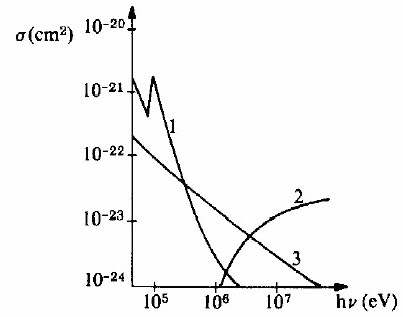
The figure above show the photon interaction cross sections for lead in the energy range where the Compton, photoelectric, and pair production processes all play a role. What is the correct identification of these cross sections?

A. 1 = Photoelectric, 2 = Compton, 3 = Pair production
B. 1 = Photoelectric, 2 = Pair production, 3 = Compton
C. 1 = Compton, 2 = Pair production, 3 = Photoelectric
D. 1 = Compton, 2 = Photoelectric, 3 = Pair production
E. 1 = Compton, 2 = Photoelectric, 3 = Compton
(GR8677 #85)
Solution:

Photoelectric Effect:
  • Low-energy photon (visible/UV/soft X-rays) interacts with matter
  • Results: emission of electron

Compton Scattering:
  • High-energy photon (X-ray/Gamma ray) interacts with electron
  • Results: emission of inelastic electron and lower energy photon

→ Energy Range: Photoelectric Effect Compton Scattering

Pair production:
  • High-energy photon (X-ray/gamma ray) interacs with nucleus
  • Results: elementary particle and its antiparticle

→ Energy Range:  Compton Scattering (electron target) Pair production (nucleus target)

→  Energy Range:  Photoelectric Compton Pair production

→ 1 = photoelectric, 2 = pair production, 3 = Compton

Answer: B

Quantum Mechanics – Selection Rules

Which of the following is NOT compatible with the selection rule that controls electric dipole emission of photons by excited states of atoms?

A. ∆n may have any negative integral value
B. ∆l = ±1
C. ∆ml = 0, ±1
D. ∆s = ±1
E. ∆j = ±1
(GR8677 #92)
Solution:

Selection rules:
1.    Principal quantum number      :      n = anything
2.Orbital angular momentum:l = ±1
3.Magnetic quantum number:ml = 0, ±1
4.Spin:s = 0
5.Total angular momentum:j = 0, ±1, but j = 0 ↛j = 0

Answer: D

Nuclear & Particle Physics – Conservation Laws

Which of the following reasons explains why a photon cannot decay to an electron and a positron γ  e− ein free space?

A. Linear momentum and energy are not both conserved
B. Linear momentum and angular momentum are not both conserved
C. Angular momentum and parity are not both conserved
D. Parity and strangeness are not both conserved
E. Charge and lepton number are not both conserved
(GR9677 #96)
Solution:

See GR0177 #99

Answer: A

Special Relativity - Relativistic Energy

A photon strikes an electron of mass m that is initially at rest, creating an electron-positron pair. The photon is destroyed and the positron and two electrons move off at equal speed along the initial direction of the photon. The energy of the photon was

A. mc2
B. 2mc2
C. 3mc2
D. 4mc2
E. 5mc2
(GR0177 #99)
Solution

Relativistic Energy: 

E = (p2c+ m02c4)1/2

Photon has no mass, m= 0, therefore,

E(photon) = (p2c)1/2 = pc

Initially, electron is at rest, thus momentum is zero, therefore,

 E(electron) = (m02c4)1/2 = mec2
 
Total initial energy of the system,

Ei = E(photon) + E(electron) = pc + mec2

After collision, 3 particles (2 electrons and a positron) move off at equal speed, thus each has p/3 momentum.

Electron and positron has the same mass.

Thus, each particle has energy,

Ef (electron) = Ef (positron) = [(p/3)2cme2c4]1/2

Total final energy of the 3 particles, Ef  = 3 [(p/3)2cme2c4]1/2

Conservation of energy, Ei = Ef 

pc + mec = 3 [(p/3)2cme2c4]1/2
(pc + mec2)= 9 [(p/3)2cme2c4]
p2c+ me2c+ 2pmec3 = 9(p/3)2c + 9me2c4
p2c+ me2c+ 2pmec3 p2c + 9me2c4
me2c+ 2pmec3 = 9me2c4
2pmec3 = 8me2c4
p = 4mec
Energy, E pc = 4mec2

Answer: D

Nuclear & Particle Physics - Compton Scattering

In the Compton effect, a photon with energy E scatters through 90o angle from stationary electron mass m. The energy of the scattered photon is

A. E
B. E/2
C. E2/mc2
D. E2/(Emc2)
E. Emc2/(E + mc2)
(GR0877 #97)
Solution: 

Compton scattering: λf − λi = h/mc (1− cosθ)
Photon energy, Ehc/λ

hc/Ef − hc/E = h/mc (1 − cos 90o)
1/Ef − 1/E = 1/mc2 (1 − 0)
1/Ef  1/mc2 1/E
Emc2/Ef  = E + mc2
Emc2/Ef  E + mc2
E = Emc2/E mc2 

Answer: E


Thermal Physics - Pressure of photon gas

Compute the pressure exerted by gas of photons.

Solution:

According to kinetic theory analysis, pressure:


Momentum: p = mv
For photon, v = c
Energy of photon: E = pc

→ Pressure:


Ideal Gas: PV = NkT

→ Pressure:


→ Energy: