Showing posts with label Classical Mechanics. Show all posts

Classical Mechanics - Circular Motion


A car travels with constant speed on a circular road on level ground. In the diagram above, Fair is the force of air resistance on the car. Which of the other force shown best represents the horizontal force of the road on the car's tires?

A. FA 
B. FB
C. FC
D. FD
E. FE
(GR9677 #05)

Solution:

FA = Centripetal force
F= Frictional force of the road, equals to force exerted by tires exert in the backward direction so that the car moves in the forward direction (Newton's third law Action-Reaction).

The horizontal force on the car’s tires, FA + FFB

Answer: B

Classical Mechanics - Friction Force


A block of mass m sliding down an incline at constant speed is initially at height h above the ground as shown in the figure. The coefficient of kinetic friction between the mass and the incline is µ. If the mass continues to side down the incline at a constant speed, how much energy is dissipated by friction by the time the mass reached the bottom of the incline?

A. mgh/µ
B. mgh
C. µmgh/sin θ 
D. mgh sin θ 
E. 0
(GR9677 #06)

Solution:

mg sin θ − Fr  ma
At a constant speed, a = 0
Fr  mg sin θ 

Energy dissipated = Work done by the frictional force
W = F⋅ s

s = length of the inclined surface = h/sin θ

W = mg sin θ (h/sin θ) = mgh

Answer: B

Classical Mechanics - Linear Momentum


As shown in the picture, a ball of mass m suspended on the end of a wire, is released from height h and collides elastically, when it is at its lowest point, with a block of mass 2m at rest on a frictionless surface. After the collision, the ball rises to a final height equal to

A. 1/9 h
B. 1/8 h
C. 1/3 h
D. 1/2 h
E. 2/3 h

(GR9677 #07)

Solution:

Conservation of momentum of the system:

mavmbvb = mavambvb

Given:
mm
m= 2m
vb = 0

mv+ 0 = mva+ 2mvb 
v = va+ 2vb   (Eq.1)

Conservation of kinetic energy of the system:

½ mava² + ½ mbvb² = ½ mava'² + ½ mbvb'²
mva² + 0 = mva'² + 2mvb'²
va² = va'² + 2vb'²  (Eq.2)

(Eq.1) → (Eq.2)
(va+ 2vb')² = va'² + 2vb'²
va'² + 4va'vb+ 4vb'² = va'² + 2vb'²
4va'vb = 2vb'² − 4vb'²
2va' = − vb'  
vb = −2va'  (Eq.3)

(Eq.3) →  (Eq.1)
v = va+ 2vb
v = va+ 2(−2va')
v = − 3va'  (Eq. 4)

For the pendulum, conservation of energy:

at the moment of the collision
U T → magh = ½ mava² → va = (2gh)½

after the collision
U'  T→ magh' = ½ mava'² → va= (2gh')½

Thus, (Eq. 4):
v = − 3va'  
(2gh)½  = − 3(2gh')½ 
[(2gh)½]² = [− 3(2gh')½

h  = 9h'
h' = ¹⁄₉h 

Answer: A

Classical Mechanics - Harmonic Oscillator

A particle of mass m undergoes harmonic oscillation with period T0. A force f proportional to the speed v of the particle, fbv, is introduced. If the particle continues to oscillate, the period with f acting is

A. Larger than T0
B. Smaller than T0
C. Independent of b
D. Dependent linearly on b
E. Constantly changing
(GR9677 #08)

Solution:

 f = bv → minus sign means f is restoring force (damped oscillation).
The oscillation is getting slower (larger period) before it finally comes to stop.

Answer: A

Classical Mechanics - Linear Momentum

A helium atom, mass 4u travels with non relativistic speed v normal to the surface of a certain material, makes an elastic collision with an (essentially free) surface atom, and leaves in the opposite direction with speed 0.6v. The atom on the surface must be an atom of

A. Hydrogen, mass 1u
B. Helium, mass 4u
C. Carbon, mass 12u
D. Oxygen, mass 16u
E. Silicon, mass 28u
(GR9677 #20)
Solution:

ma = 4u
v = v
v = 0
va= − 0.6v

Conservation of momentum of the system:

mavmbvb = mavambvb
4uv = 4u(− 0.6v) mbvb
4uv = − 2.4uv  mbvb
mbvb= 6.4uv (Eq.1)

Conservation of kinetic energy of the system:

½ mava² + ½ mbvb² = ½ mava'² + ½ mbvb'²
4uv² 4u(− 0.6v)² + mbvb'²
4uv² 4u(0.36v²) + mbvb'²
mbvb'² =  4uv²  − 1.44uv²
mbvb'² =  2.56uv² (Eq.2)

(Eq.1) → (Eq.2)
6.4 (vb') = 2.56v
vb' =  (2.56/6.4)= 0.4v  (Eq.3)

(Eq.3) → (Eq.1)
m= 6.4u/ 0.4= 16u

Answer: D

Classical Mechanics - Moment Inertia

The period of physical pendulum is 2π(I/mgd), where I is the moment of inertia about the pivot point and d is the distance from the pivot to the center of mass. A circular hoop hangs from a nail on a barn wall. The mass of the hoop is 3 kilograms and its radius is 20 centimeters. If it is displaced slightly by a passing breeze, what is the period of the resulting oscillations?

A. 0.63 s
B. 1.0 s
C. 1.3 s
D. 1.8 s
E. 2.1 s
(GR9677 #21)
Solution:

T2π(I/mgd)
= 3 kg
= 20 cm = 0.2 m
In this case r

To find total I:
Parallel axis theorem: I = ml2 + ICM
ICM  Iloop mr

In this case l r
→ I = mr2 + mr= 2mr2

T 2π(2mr2 mgr
2π(2r/g
2π√[2(0.2)/(10)] 
2π(0.2)
= 1.25 s

Answer: C

Classical Mechanics - Curved Trajectory

The curvature of Mars is such that its surface drops a vertical distance of 2.0 meters for every 3600 meters tangent to the surface. In addition, the gravitational acceleration near its surface is 0.4 times that near the surface of Earth. What is the speed a golf ball would need to orbit Mars near the surface, ignoring the effects of air resistance?

A. 0.9 km/s
B. 1.8 km/s
C. 3.6 km/s
D. 4.5 km/s
E. 5.4 km/s
(GR9677 #22)
Solution:


y = ½ gmarst2
v= x/t 

Given:
y = 2
gmars = 0.4 g 
3600

2 = ½(0.4)(10)(t)2
t = 1 s
v= 3600/1 = 3600 m/s = 3.6 km/s

Answer: C


Classical Mechanics - Conservative Force

Suppose that the gravitational force law between two massive objects were

F12 = 12 Gm1m2/r12(2+ɛ) 

where ɛ is a small positive number. Which of the following statements would be FALSE?
  1. The total mechanical energy of the planet-Sun system would be conserved.
  2. The angular momentum of a single planet moving about the Sun would be conserved.
  3. The periods of planets in circular orbits would be proportional to the (3+ɛ)/2 power of their respective orbital radii.
  4. A single planet could move in a stationary non circular elliptical orbit about the Sun.
  5. A single planet could move in a stationary circular orbit about the Sun.
(GR9677 #23)
Solution:

(A) TRUE.
Gravitational force is a conservative force.
In conservative field, the total mechanical energy is conserved.

(B) TRUE
In conservative field, angular momentum, L is conserved.

(C) TRUE
FFc
GMm/r(2+ɛ) mrω2
GMm/r(2+ɛ) mr(2π/T)2
GM/r(3+ɛ) = 4π2/T2
T= 4π2r(3+ɛ)/GM
T ∝ r(3+ɛ)/2 

(D) FALSE
Central force = centripetal force (FFc) produces circular orbit.
Non central forces do not produce circular orbit.

(E) TRUE
See (D)

Answer: D

Notes:

Central force:
  1. It is a force whose magnitude depends only on the distance between the object and the origin.
  2. It is a conservative field, can be expressed as F = − ∇V (the negative gradient of a potential energy).
  3. Gravitational force, Coulomb force, and Elastic Force (Harmonic Oscillator) are examples of central (conservative) forces.
  4. In conservative field, the net work done by the force is zero, W = ∮c F ∙ dr = 0 → the total mechanical energy is conserved.
  5. Conservative force is irrotional (torque = 0), since curl ∇or ∇ × ∇= 0.
  6. Torque, τ = dL/dT = 0 → angular momentum, L is conserved
  7. Central force = centripetal force (FFc) produces circular orbit.

Classical Mechanics - Fluid


An open-ended U-tube of uniform cross-sectional area contains water (density 1.0 gram/cm3) standing initially 20 cm from the bottom in each arm. An immiscible liquid of density 4.0 gr/cm3 is added to one arm until a layer 5 cm high forms. What is the ratio h2/h1 of the heights of the liquid in the two arms?

A. 3/1
B. 5/2
C. 2/1
D. 3/2
E. 1/1
(GR9677 #30)
Solution:


Given:
ρwater = 1 gr/cm3
ρliquid = 4 gr/cm3
ha = 5 cm

PP2
ρlgha ρwghb 
hb ρlhρw = (4)(5) / (1) = 20

hh + ha  
hh + h
-------------- −
h− hh− h = 5 − 20 = − 15 (Eq.1)

Initially, hh= 20 + 20 = 40
Finally, hh= 40 + 5 = 45 (Eq.2)

(Eq.1) → h− h= − 15
(Eq.2) → hh= 45
------------------------------ +
2h= − 15 + 45 = 30
h= 15

h= 45 − 15 = 30

h2/h1 = 30/15 = 2

Answer: C


Classical Mechanics - Fluid

A sphere of mass m is released from rest in a stationary viscous medium. In addition to the gravitational force of magnitude mg, the sphere experiences a retarding force of magnitude bv, where v is the speed of the sphere and b is a constant. Assume that the buoyant force is negligible. Which of the following statements about the sphere is correct?
  1. Its kinetic energy decreases due to the retarding force.
  2. Its kinetic energy increases to a maximum, then decreases to zero due to the retarding force.
  3. Its speed increases to a maximum, then decreases back to a final terminal speed.
  4. Its speed increases monotonically, approaching a terminal speed that depends on b but not on m.
  5. Its speed increases monotonically, approaching a terminal speed that depends on b and m.
(GR9677 #31)
Solution:


ma mg − bv

Terminal speed, a = 0

mg bv
mg/→ (E) TRUE


(A) FALSE.
m is released from rest vi = 0 → KE= 0

(B) FALSE.
Terminal speed released from rest vf  mg/b ≠ 0 → KEf  ≠ 0

(C) FALSE.
vi = 0 to vf  mg/b, no vmax

(D) FALSE.
 vf  mg/b, depend on both m and b

Answer: E


Classical Mechanics - Rotational Kinetic Energy


Three equal masses m are rigidly connected to each other by massless rods of length l forming an equilateral triangle. The assembly is to be given an angular velocity ω about an axis perpendicular to the triangle. For fixed ω, the ratio of the kinetic energy of the assembly for an axis through B compared with that for an axis through A is equal to

A. 3
B. 2
C. 1
D. 1/2
E. 1/3
(GR9677 #32)
Solution:

KE = ½Iω2

For fix ω, the ratio KEB/KEIB/IA

I = ∑miri2

From A:
m1mmm
x1xxl/√3 (see notes)

I= m1x1m2x2m3x32
= 3ml/√3)ml2

From B:
Im1x1m2x2
mlml2 = 2ml2

KEA/KE= 2ml2/ml= 2

Answer: B

Notes:


Cos 30o = ½x
Cos 30o = ½√3
½x= ½√3
x= xxl/√3 

Classical Mechanics - Acceleration

A particle of unit mass undergoes one-dimensional motion such that its velocity varies according to v(x) = βxn where β and n are constants and is the position of the particle. What is the acceleration of the particle as a function of x?

A. −2x−2n−1
B. −2xn−1
C. −2xn
D. −β2xn+1
E. −β2x−2n+1
(GR9677 #44)
Solution:

dv/dt = (dv/dx) (dx/dt) =  (dv/dx) v

Given: v(x) = βxn
dv/dx =  nβxn−1

Thus, (nβxn−1βx2x−2n−1

Answer: A

Classical Mechanics - Conservation of Momentum

A man of mass m on an initially stationary boat gets off the boat by leaping to the left in an exactly horizontal direction. Immediately after the leap, the boat of mass M is observed to be moving to the right at speed v. How much work did the man do during the leap (both on his own body and on the boat)?

A. ½ Mv²
B. ½ mv²
C. ½ (m)v²
D. ½ (M²/m)v²
E. ½ [Mm/(m)]v²
(GR9677 #65)
Solution:

Conservation of momentum:


The man does work on both himself and the boat:


Answer: D

Classical Mechanics - Orbital Path

When it is about the same distance from the Sun as is Jupiter, a spacecraft on a mission to the outer planets has a speed that is 1.5 times the speed of Jupiter in its orbit. Which of the following describes the orbit of the spacecraft about the Sun?

A. Spiral
B. Circle
C. Ellipse
D. Parabola
E. Hyperbola
(GR9677 #66)
Solution:

The mission is to outer planets, so the path should not be bounded (no longer a close path): A, B, C are FALSE.

If vescape = vcircular → Parabola
If ve  √2 v→ Hyperbola
Since ve = 1.5  √2 → Hyperbola

Answer: E

Notes:

To find escape velocity:
Fc = F
mv2r = GMm r
vcircular (GM r)

KE = PEgravity 
½ mvGMm r  
vescape (2GM r) = (GM r)
vescape = vcircular

Classical Mechanics - Lagrangian


A bead is constrained to slide on a frictionless rod that is fixed at an angle θ with a vertical axis and is rotating with angular frequency ω about the axis, as shown above. Taking the distance s along the rod as the variable, the Lagrangian for the bead is equal to

A. ½ mṡ ² − mgs cos θ 
B. ½ mṡ ² + ½ m(ωs − mgs 
C. ½ mṡ ² + ½ m(ωcos θ + mgs cos θ
D. ½ m(ṡ sin θ)² − mgs cos θ 
E. ½ mṡ ² + ½ m(ωsin θ − mgs cos θ
(GR9677 #68)
Solution:

Lagrangian: L = T U

Potential energy: U = mgh = mgs cos θ 
Kinetic Energy:  Tkin  =  ½ mṡ ²
Rotational kinetic energy:  Trot =  ½ ²
with moment inertia: = mr²  = m(sin θ
→ Trot = ½ m(ωsin θ

Tkin Trot − U =  ½ mṡ ² + ½ m(ωsin θ − mgs cos θ

Answer: E

Classical Mechanics - Pendulum


Two pendulums are attached to a massless spring, as shown above. The arms of the pendulums are of identical lengths l, but the pendulum balls have unequal masses m1 and m2. The initial distance between the masses is the equilibrium length of the spring, which has spring contant K. What is the highest normal mode frequency of this system?

A.

B.

C.

D.

E.
(GR9677 #84)
Solution:

A. FALSE
ω = √(g/l) is angular frequency for single pendulum

B. and C are FALSE
Both answers do not depend on g/l

D. TRUE
If there is no dependence on → ω = √(g/l)
And if m2 → ∞,  mwill still oscillate with spring constant K but has no dependence on m2as if it were connected to a stationary object.

E. FALSE
If there is no dependence on K → ω = √(2g/l), not angular frequency for single pendulum
And if m2 → ∞,  ω = √(2g/l) has no dependence on and m1

Answer: D 

Classical Mechanics - Earth’s gravitational force

Questions 4-5

The magnitude of the Earth’s gravitational force on a point mass is F(r), where r is the distance from the Earth’s center to the point mass. Assume the Earth is a homogeneous sphere of radius R.

What is

A. 32
B. 8
C. 4
D. 2
E. 1
(GR9277 #04)
Solution:

Gravity force: F = GMm/R→ F ∝ 1/R2

F(R) ∝ 1/R2
F(2R) ∝ 1/4R2

F(RF(2R) = 4R2R= 4

Answer: C

Classical Mechanics - Gravitation

Questions 4-5

The magnitude of the Earth’s gravitational force on a point mass is F(r), where r is the distance from the Earth’s center to the point mass. Assume the Earth is a homogeneous sphere of radius R

Suppose there is a very small shaft in the Earth such that the point mass can be placed at a radius of R/2. What is ?

A. 8
B. 4
C. 2
D. 1/2
E. 1/4
(GR9277 #05)
Solution:

Newton's law of gravity becomes a linear law inside a body → F ∝ r
F(R) ∝ R
F(R/2) ∝ R/2


Answer: C

Classical Mechanics - Friction Force


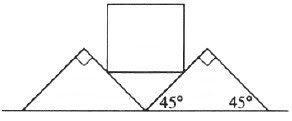
Two wedges, each of mass m, are placed next to each other on a flat floor. A cube of mass M is balanced on the wedges as shown above. Assume no friction between the cube and the wedges, but a coefficient of static friction between the wedges and the floor. What is the largest M that can be balanced as shown without motion of the wedges?

A.

B.

C.

D.

E. All M will balance
(GR9277 #06)
Solution:


Answer: D

Classical Mechanics - Pendulum


A cylindrical tube of mass M can slide on a horizontal wire. Two identical pendulum, each of mass m and length l, hang from the ends of the tube, as shown above. For small oscillations of the pendulums in the plane of the paper, the eigenfrequencies of the normal modes of oscillation of the system are 0,,   and …

A.

B.

C.

D.

E.
(GR9277 #07)
Solution:

2 modes in which the system can oscillate:

1. The 2 pendulum oscillate out of phase so there is torsional effect on the tube → there is M in the equation.


2. In phase → no torsional effect on M → No M in the equation.


Answer: A