Showing posts with label Standard Deviation. Show all posts

Lab Methods - Standard Deviation

The magnitude of the force F on an object can be determined by measuring both the mass m of an object and the magnitude of its acceleration a, where F = ma. Assume that these measurements are uncorrelated and normally distributed. if the standard deviations of the measurements of the mass and acceleration are σm and σa respectively, then σF/F is

A.

B.

C.

D.

E.
(GR9277 #48)

Solution:

Multiplying two quantities with uncertainty:

u = x ⋅ y


For F = ma:


Answer: C

Nuclear & Particle Physics - Radioactive

An experimenter measures 9924 counts during one hour from a radioactive sample. From this number the counting rate of the sample can be estimated with a standard deviation of most nearly 

A. 100
B. 200
C. 300
D. 400
E. 500
(GR8677 #40)
Solution:

Radioactive decay can be described by Poisson Distribution.

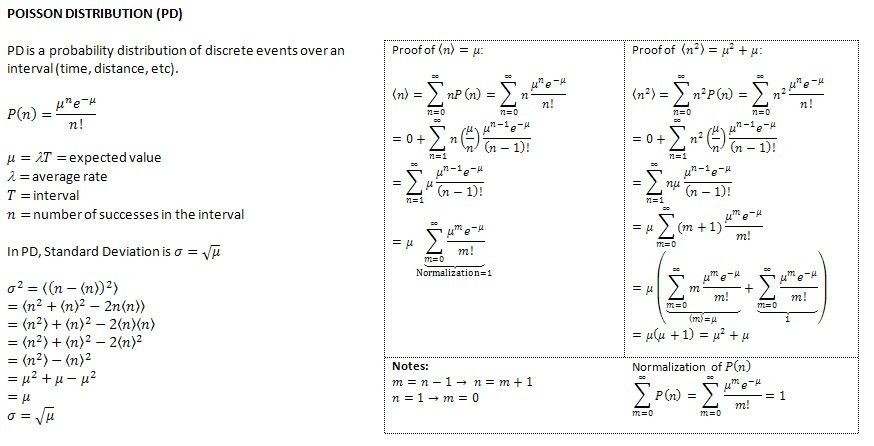
Poisson Distribution (PD):
Probability distribution of discrete events over an interval (time. distance, etc)

In PD, Standard Deviation, σ = √μ (see Notes)
μ = expected number of events

Given: μ = 9924 ≈ 10000
σ = √10000 = 100

Answer: A


Notes: (click to enlarge)


Lab Methods - Uncertainty

A student makes 10 one-second measurement of the disintegration of a sample of a long lived radioactive isotope and obtains a following values: 3, 0, 2, 1, 2, 4, 0, 1, 2, 5. How long should the student count to establish the rate to an uncertainty of 1 percent?

A. 80 s
B. 160 s
C. 2000 s
D. 5000 s
E. 6400 s
(GR0177 #16)
Solution:

Radioactive decay can be described by Poisson Distribution.

Poisson Distribution (PD):
Probability distribution of discrete events over an interval (time. distance, etc)

In PD, Standard Deviation, σ = √μ  (see problem GR8677 #40)
μ = λT = expected value
λ = average rate
T = time interval

% Uncertainty = (σ/μ) × 100%

σ/μ = 0.01
√μ/μ = 10−2
μ/μ2 = 10−4
1/μ = 1/104
μ = λT = 104

λ = (3 + 0 + 2 + 1 + 2 + 4 + 0 + 1 + 2 + 5)/10 = 2
T = 104/2 = 5000

Answer: D