Showing posts with label X-rays. Show all posts

Nuclear & Particle Physics - Bragg Diffraction

The longest wavelength X-ray that can undergo Bragg diffraction in a crystal for a given family of planes of spacing d is

A. d/4
B. d/2
C. d
D. 2d
E. 4d
(GR9277 #02)
Solution:

Bragg’s law: 2d sin θ 

Maximum → sin θ = 1

and = 1 (1st order)

λ = 2d

Answer: D

Nuclear & Particle Physics - X-rays

The ratio of the energies of the K characteristic X-rays of carbon (Z = 6) to those of magnesium (Z = 12) is most nearly

A. 1/4
B. 1/2
C. 1
D. 2
E. 4
(GR9277 #03)
Solution:
Moseley’s law:


K-series refers to a transition from some outer state, ni to the inner-most shell, nf = 1.
(The order from inner to outer → K, L, M, N).

E ≈ (Z − 1)2

Ecarbon = (6 − 1)2 = 25
Emagnesium = (12 − 1)2 = 121

The ratio = 25/121 ≈ 1/4

Answer: A

Nuclear & Particle Physics - X-rays

A beam of electrons is accelerated through a potential difference of 25 kV in an X-ray tube. The continuous X-ray spectrum emitted by the target of the tube will have a short wavelength limit of most nearly

A. 0.1 Å
B. 0.5 Å
C. 2 Å
D. 25 Å
E. 50 Å
(GR9277 #80)
Solution:

Energy: E = pc
Wavelength: λ = h/p = hc/E

E = 25 kV
h = 4.14 × 10⁻¹⁵ eV second
c = 3 × 10⁸ m/s
hc = 1.24 × 10⁻⁶ eVm

λ = 1.24 × 10⁻⁶/25 × 10 = ½ × 10−10 m = 0.5 Å

Answer: B

Nuclear & Particle Physics - X-rays

A nickel target (Z = 28) is bombarded with fast electron. The minimum electron kinetic energy needed to produce X-rays in the K-series is most nearly

A. 10 eV
B. 100 eV
C. 1000 eV
D. 10,000 eV
E. 100,000 eV
(GR8677 #26)
Solution:
Moseley’s law:

K-series refers to a transition from some outer state, ni to the inner-most shell, nf = 1.
(The order from inner to outer → K, L, M, N).

As the electrons come in from ni = ∞,


Answer: D

Special Relativity - Index of Refraction

The measured index of refraction of X-rays in rock salt is less than one. This is consistent with the theory of relativity because

A. Relativity deals with light waves traveling in a vacuum only
B. X-rays cannot transmit signal
C. X-rays photons have imaginary mass
D. The theory of relativity predates the development of solid-state physics
E. The phase velocity and group velocity are different
(GR8677 #72)
Solution:

Index of refraction, n = c/v

For X-rays,  1 → v  c (violates the theory of special relativity)
However, this is OK, because in this case, v is phase velocity, vp.

vdoes not represent the particle velocity.
The physical speed of particle is represented by group velocity, vg.

Answer: E

Nuclear & Particle Physics - Photon Interactions


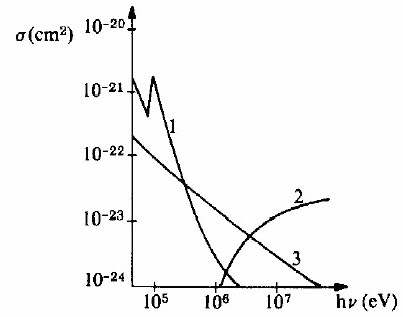
The figure above show the photon interaction cross sections for lead in the energy range where the Compton, photoelectric, and pair production processes all play a role. What is the correct identification of these cross sections?

A. 1 = Photoelectric, 2 = Compton, 3 = Pair production
B. 1 = Photoelectric, 2 = Pair production, 3 = Compton
C. 1 = Compton, 2 = Pair production, 3 = Photoelectric
D. 1 = Compton, 2 = Photoelectric, 3 = Pair production
E. 1 = Compton, 2 = Photoelectric, 3 = Compton
(GR8677 #85)
Solution:

Photoelectric Effect:
  • Low-energy photon (visible/UV/soft X-rays) interacts with matter
  • Results: emission of electron

Compton Scattering:
  • High-energy photon (X-ray/Gamma ray) interacts with electron
  • Results: emission of inelastic electron and lower energy photon

→ Energy Range: Photoelectric Effect Compton Scattering

Pair production:
  • High-energy photon (X-ray/gamma ray) interacs with nucleus
  • Results: elementary particle and its antiparticle

→ Energy Range:  Compton Scattering (electron target) Pair production (nucleus target)

→  Energy Range:  Photoelectric Compton Pair production

→ 1 = photoelectric, 2 = pair production, 3 = Compton

Answer: B

Nuclear & Particle Physics - X-rays

In the production of X-rays, the term “bremsstrahlung” refers to which of the following?
  1. The cut-off wavelength, λmin, of the X-ray tube
  2. The discrete X-ray lines emitted when an electron in an outer orbit fills a vacancy in an inner orbit of the atoms in the target metal of the X-ray tube
  3. The discrete X-ray lines absorbed when an electron in an inner the X-ray tube
  4. The smooth, continuous X-ray spectra produced by high-energy blackbody radiation from the X-ray tube
  5. The smooth, continuous X-ray spectra produced by rapidly decelerating electron in the target metal of the X-ray tube
(GR0177 #20)
Solution:

Bremsstrahlung is German for ‘braking radiation’.

This is the radiation that is released as the electron slows down or is “braked” and results in a continuous spectra.

Answer: E

Nuclear & Particle Physics - Bragg Diffraction

When a narrow beam of monoenergetic electrons impinges on the surface of a single metal crystal at an angle of 30 degrees with the plane of the surface, first-order reflection is observed. If the spacing of the reflecting crystal planes is know from x-rays measurements to be 3 Angstrom, the speed of the electron is most nearly

A. 1.4  × 10−4 m/s
B. 2.4 m/s
C. 5.0  × 10m/s
D. 2.4  × 10m/s
E. 4.5  × 10m/s
(GR8677 #91)
Solution:

Bragg's Law: nλ = 2d sin θ 

De Broglie wavelength: λ h/mev

h/me2sin θ n
nh / (2mesin θ)

Given:
n = 1 (first-order reflection)
d = 3 Angstrom = 3 × 10−10 m
θ = 30 →  sin 30 = 0.5
m=  9.11 × 10−31 kg
h = 6.63 × 10−34 Js

= (6.63 × 10−34)/[2( 9.11 × 10−31)(3 × 10−10)(0.5)]
= [6.63/(9.11 × 3)] × 10−34 × 1041
= [2/(3 × 3)] × 10 0.22 × 10= 2.2 × 10m/s  

Answer: D