Showing posts with label Binding Energy. Show all posts

Nuclear & Particle Physics - Binding Energy

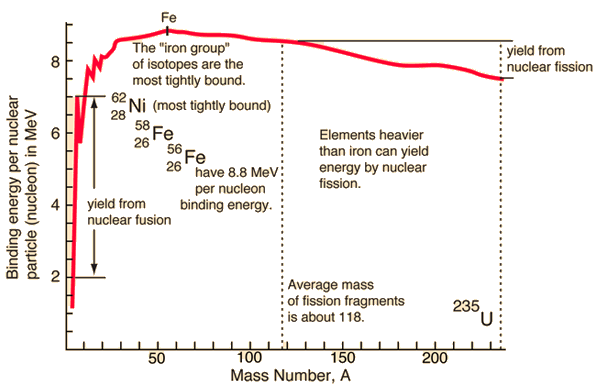
The binding energy of a heavy nucleus is about 7 million electron volts per nucleon, whereas the binding energy of a medium-weight nucleus is about 8 million electron volts per nucleon. Therefore, the total kinetic energy liberated when a heavy nucleus undergoes symmetric fission is most nearly

A. 1876 MeV
B. 938 MeV
C. 200 MeV
D. 8 MeV
E. 7 MeV
(GR9677 #64)
Solution:

KEEf   Ei

Symmetric fission: the splitting of the nucleus into two fragments of approximately equal mass.

AX  →  A1Y  + A2Z
with A1 =  A= A/2 and Y = Z  (for symmetric fission)

A Ei  → A1 Ef 1 + AEf = 2(A/2) Ef  = A Ef 

KE = A Ef  − A E = A (8  − 7) MeV/nucleon = A MeV/nucleon

For heavy nucleus, A ≈ 200 nucleons. Example: 238U → A ≈ 238 nucleons

→ KE ≈ 200  MeV

Answer: C

Nuclear & Particle Physics - Positronium

Given that the binding energy of the hydrogen atom ground state is E0 = 13.6 eV, the binding energy of n = 2 state of positronium (positron-electron system) is

A. 8E0
B. 4E0
C. E0
D. E0/4
E. E0/8
(GR9277 #30)
Solution:

Energy levels of Positronium is half those of Hydrogen (See GR8677 #99)

En(H)  = − 13.6 / n²
En(Ps) ½ En(H)  

For n = 2,

E2(Ps) ½ × ( − 13.6 / 2²)  = − E0/8

Answer: E

Nuclear & Particle Physics - Binding Energy

Which of the following nuclei has the largest binding energy per nucleon? (Consider the most abundant isotope of each element.) 

A. Helium
B. Carbon
C. Iron
D. Uranium
E. Plutonium
(GR8677 #41)
Solution:

Uranium and Plutonium: decay spontaneously → very low binding energy.
Iron: the most stable element → tightly bound → the largest binding energy.


Source: hyperphysics.phy-astr.gsu.edu

Answer: C

Nuclear & Particle Physics - Binding Energy

The 238U nucleus has a binding energy of about 7.6 MeV per nucleon. If the nucleus were to fission into two equal fragments, each would have a kinetic energy of just over 100 MeV. From this it can be concluded that

A. 238U cannot fission spontaneously
B. 238U has a large neutron excess
C. nuclei near A = 120 have masses greater than half that of 238U
D. nuclei near A = 120 must be bound by about 6.7 MeV/nucleon
E. nuclei near A = 120 must be bound by about 8.5 MeV/nucleon
(GR0177 #67)
Solution:

(A) FALSE.
238U is a heavy element, it can fission spontaneously.

(B) FALSE.
It is not related to binding energy

(C) FALSE.
Total mass of nucleus is always less than the sum of the masses of its individual nucleons.

(D) FALSE.
Nuclei near A = 120 must be bound by energy greater than A = 238 (must be more than 7.6 MeV per nucleon)

(E) TRUE.
8.5 MeV/nucleon is more than 7.6 MeV per nucleon.

Answer: E

Notes:

To calculate the binding energy per nucleon:

238U → A = 238 ≈ 240
238U nucleus were to fission into two equal fragments: A1 = A2 = A' = 240/2 = 120

Initial binding energy: Ei = 240 × 7.6 MeV

Final binding energy: Ef = 120 E + 120 E = 240 E 

The kinetic energy of the two fragments is the difference in binding energy between the initial and final state nuclei:


Thus, nuclei near A = 120 must be bound by about 8.5 MeV/nucleon

The graph also shows that for A = 120, binding energy is about 8.5 MeV/nucleon


Source: hyperphysics.phy-astr.gsu.edu