Showing posts with label Polarization. Show all posts

Electromagnetism - Polarization

Questions 54-55 concern a plane electromagnetic wave that is a superposition of two independent orthogonal plane waves and can be written as the real part of 

E =  E1 exp [i(kz ωt)] +   Eexp [i(kz − ωt + π)]
where kωE1 and E2 are real

If the plane wave is split and recombined on a screen after the two portions, which are polarized in the x- and y- directions, have traveled an optical path difference of 2π/k, the observed average intensity will be proportional to

A. E1² E2² 
B. E1² − E2² 
C. (E1E2 
D. (E1− E2 
E. 0
(GR9677 #55)
Solution:

E = x̂ E1 ei(kz − ωt   E ei(kz − ωt +π 

Path difference of 2π/k
E = x̂ E1 ei(kz − ωt   E ei[k(z + 2π/k) − ωt π

E = x̂ E1 ei(kz − ωt   E ei[kz − ωt· ei3π 
ei3π = −1

E = x̂ E1 ei(kz − ωt    E ei(kz − ωt

Intensity in the x- directions, Ix = |E1|²  
Intensity in the x- directions, Iy = |E2 

Itotal IIy E1² E2²

Answer: A

Optics - Polarization


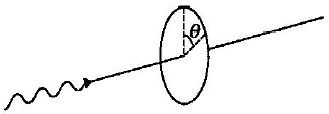
A steady of light is normally incident on a piece of Polaroid. As the Polaroid is rotated around the beam axis, the transmitted intensity varies as A + B cos 2θ where θ is the angle of rotation, and A and B are constants with . Which of the following may be correctly concluded about the incident light? 

A. The light is completely unpolarized
B. The light is completely plane polarized
C. The light is partly plane polarized and partly unpolarized
D. The light is partly circularly polarized and partly unpolarized
E. The light is completely circularly polarized
(GR9277 #67)
Solution:

Malus' Law: for plane-polarized light, I = I0 cos2θ
Trig identity: cos2θ =  ½ (1 + cos 2θ) 

If A = B, the light is completely plane polarized, but A > > 0

When cos2θ = 0, I = A = constant → unpolarized.

Thus, the light is partly plane polarized and partly unpolarized

Answer: C

Electromagnetism - Dielectric


A dielectric of dielectric constant K is placed in contact with a conductor having surface charge density σ, as shown above. What is the polarization (bound) charge density σp on the surface of the dielectric at the interface between the two materials? 

A. σ/ (1−K)
B. / (1 + K)
C. σK
D. σ(1 + K) / K
E. σ(1 − K) / K
(GR8677 #54)
Solution:

Polarization, Pɛ0χeEɛ0(K − 1)E
Thus,  1.
If K = 1 → P = 0 and σ= 0 → no polarized dielectric

Check answers for = 1→ σ= 0

(A) σσK/(1 − K) = ∞ → FALSE
(B) σK/(1 + K) = 1/2 → FALSE
(C) σσσ → FALSE
(D) σσ(1 + K)/= 2σ → FALSE
(E) σσ(1 − K)/K = 0 → TRUE

Answer: E 


Alternative Solution:

In dielectric, E σ/ɛ σ/ɛ0K
Polarization, P = ɛ0(K − 1)E
σp = ɛ0(K − 1)(σ/ɛ0K)
= (K − 1)(σ/K)
σ(1 − K)/K

Optics - Polarization

Unpolarized light is incident on two ideal polarizers in series. The polarizers are oriented so that no light emerges through the second polarizer. A third polarizer is now inserted between the first two and its orientation direction is continuously rotated through 180o. The maximum fraction of the incident power transmitted through all three polarizers is

A. Zero
B. 1/8
C. 1/2
D. 1/√2
E. 1
(GR8677 #74)
Solution:

Power ~ Intensity

The maximum fraction of intensity is: I = I0/8 (see GR0177 #51)

P = P0/8

Answer: B

Optics - Polarization

Unpolarized light of intensity I0 is incident on a series of three polarizing filters. The axis of the second filter is oriented at 45o to that of the first filter, while the axis of the third filter is oriented at 90o to that of the first filter. What is the intensity of the light transmitted through the third filter?

A. 0
B. I0/8
C. I0/4
D. I0/2
E. I0/√2
(GR0177 #51)
Solution:

Polarizer:
The first filter always reduces the intensity of the light to half, I1I0
The next filter reduces the intensity by In = I(n-1) cos2 θ
θ is the angle with respect to the nth filter.

Thus,
I1 = ½ I0

I2 = I1 (cos 45)2 = I1 (½ √2)2 = ½ I1 = ¼ I0

I3=I2 (cos 45)2 = ½ I2 = I0/8

Answer: B