Showing posts with label Thin Film. Show all posts

Optics - Thin Film

Consider two horizontal glass plate with a thin film of air between them. For what values of the thickness of the film of air will the film, as seen by reflected light, appear bright if it is illuminated normally from above by blue light of wavelength 488 nanometers?

A. 0, 122 nm, 244 nm
B. 0, 122 nm, 366 nm
C. 0, 244 nm, 488 nm
D. 122 nm, 244 nm, 366 nm
E. 122 nm, 366 nm, 610 nm
(GR9677 #82)
Solution:

See Thin Film.

Glass to Air: n n→ Δ= 0
Air to Glass: n n→  Δ= 2t  λ

Δ = Δ− Δ= 2t  + ½λ

Blue Light → Constructive Interference: Δ =
→  =  2t  + ½λ
→ t = ½λ(m − ½)
with λa = 488 nm and m = 0,1,2,3...
m = 1 →  t = ½λ(1 − ½) = ¼ λ = 122 nm
m = 2 →  t = ½λ(2 − ½) = ¾ λ = 366 nm
m = 3 →  t = ½λ(3 − ½) = ⁵/4 λ = 610 nm

Answer: E

Optics - Thin Film

A soap film with index of refraction greater than air is formed on a circular wire frame that is held in a vertical plane. The film is viewed by reflected light from a white-light source. Bands of color are observed at the lower parts of the soap film, but the area near the top appears black. A correct explanation for this phenomenon would involve which of the following?

I. The top of the soap film absorbs all the light incident on it; none is transmitted.

II. The thickness of the top part of the soap film has become much less than a wavelength of visible light.

III. There a phase change of 180o for all wave-lengths of light reflected from the front surface of the soap film.

IV. There is no phase change for any wavelength of light reflected from the back surface of the soap film

A. I only
B. II and III only
C. III and IV only
D. I, II and III
E. II, III and IV
(GR9277 #21)
Solution:


I. FALSE. 
Soap film does not absorb light.

II. TRUE.
The gravity effect on water molecules decreases the thickness, t of the top of the soap film, become much less than a wavelength, λ of visible light.

When t ≪ λ, the path difference between the front and the rear surface reflections is small compared to λ. It causes an insignificant phase shift. The result is complete destructive interference of the 2 light waves, creating a black band.

III and IV. TRUE.

Thin film: 
n1〈  n→ there is 180phase change
nn→ no phase change 
n = refractive index

From air to soap (front surface):
nair〈  nsoap → 180phase change

From soap to air (back surface):
nsoap nair → no phase change 


Answer: E

Optics - Thin Film

It is necessary to coat a glass lens with a non-reflecting layer. If the wavelength of the light in the coating is λ, the best choice is a layer of material having an index of refraction between those of glass and air and a thickness of

A. λ/4
B. λ/2
C. λ/√2
D. λ
E. 1.5λ
(GR8677 #73)
Solution:
Index of refraction: 

Air to Layer,
phase difference: Δa = λ/2

Layer to Glass,
phase difference: Δb = 2t + λ/2

The relative shift: Δ = Δb − Δa =  2t + λ/2 − λ/2 = 2t

Non-reflecting → destructive interference
Δ = (m +½)λ

m = 0 (the thinnest the better)
2t = (0 +½)λ
t = λ/4

Answer: A


Notes: Click HERE for more info on Thin Film.

Optics - Thin Film

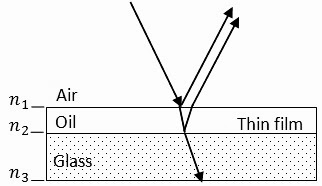
Blue light of wavelength 480 nanometers is most strongly reflected off a thin film of oil on a glass slide when viewed near normal incidence. Assuming that the index of refraction of the oil is 1.2 and that of the glass is 1.6, what is the minimum thickness of the oil film (other than zero)?

A. 150 nm
B. 200 nm
C. 300 nm
D. 400 nm
E. 480 nm
(GR0177 #69)
Solution:

n= 1
n= 1.2
n= 1.6

n n→ Δa λ/2
n n→ Δb = 2tλ/2

The Relative Shift:
Δ = Δb − Δa = 2t + λ/2 − λ/2 = 2t

For Constructive Interference: Δ =
For Destructive Interference: Δ = (m + ½)λ
with m = 0, 1, 2, 3, ...

Blue Light → Constructive interference, Δ = 

Δ =  = 2t
/2

λ 480 nm
m = 1 for minimum thickness other than 0,

t = 480/2 = 240 nm

Answer: B


Notes: Click HERE for more info on Thin Film.

Theory: Optics - Thin Film

Pulses along a rope when reflected off a fixed-end are inverted, and when reflected off a free-end, remain in phase. Light waves also exhibit these behaviors when they encounter an interface between two mediums.

Click picture to enlarge

These reflective properties are critical to our understanding of the colors in such thin films as soap bubbles, coatings on camera lenses, colors in a butterfly's wings or peacock's feathers, or oil spills.

Below is a diagram of a thin film and the light rays associated with the reflections and refractions as light impinges on the film.


When ray 1 strikes the top interface, some of the light is partially reflected, ray 2, and the rest is refracted, ray 3.

When ray 3 strikes the bottom interface, some of it is reflected, ray 4, and the remainder is refracted, ray 6.

When ray 4 strikes the top interface from underneath, some is reflected (not shown) and some is refracted, ray 5.

It is the interference between rays 2 and 5 that produces a thin film's color when the film is viewed from above.

The refracted rays remain in-phase with their initial rays.

A good method for analyzing a thin-film problem involves these steps:

Step 1
Find the shift for the wave reflecting off the top surface of the film,

Step 2
Find the shift for the wave reflecting off the film's bottom surface,


Step 3
Calculate the relative shift by subtracting the individual shifts:


Step 4
Set the relative shift equal to the condition for constructive interference, or the condition for destructive interference.
Constructive Interference:
Destructive Interference:
with

Step 5
Rearrange the equation.

Step 6
Since we are dealing with the behavior of the light in the thin film, we must ALWAYS use the light's wavelength IN THE FILM, . The wavelength in a medium whose refractive index, n is :

Step 7
Solve

Source: physicslab.org, physics.bu.edu


Example:
A thin soap film is formed by dipping a plastic rectangular wand into a solution of soapy water which has a refractive index of 1.4. When viewed in daylight, one portion of the film reflects blue light of wavelength 475 nm. Estimate the minimum thickness of that section of the film.


Will ray 2 be in-phase or out-of-phase with ray 1?
Air to Soap,   fixed-end reflector rays 1 and 2 out-of-phase with a phase inversion of

Will ray 5 be in-phase or out-of-phase with ray 1?
Ray 5: Soap to Air,   free-end reflector, in-phase with ray 2, also with 3 and 4.

Since refracted rays remain in-phase with their initial rays, it means ray 1 is also in-phase.

Thus, rays 1 and 5 are in-phase with no phase inversion.

To find minimum thickness,

Step 1.
Air to Soap,

Step 2.
Soap to Air,   (no phase difference)

Step 3.


Step 4.
Blue light Constructive Interference,

Step 5.


Step 6.


Step 7.

with (minimum thickness)