Showing posts with label #69. Show all posts

Electromagnetism - Conductor


Two long conductors are arranged as shown above to form overlapping cylinders, each of radius r, whose centers are separated by a distance d. Current of density J flows into the plane of the page along the shaded part of one conductor and equal current flows out of the plane of the page along the shaded portion of the other, as shown. What are the magnitude and direction of the magnetic field at point A?

A. (µ0 ⁄ 2π)πdJ, in the +y-direction
B. (µ0 ⁄ 2π)d2⁄ r, in the +y-direction
C. (µ0 ⁄ 2π)4d2⁄ r, in the −y-direction
D. (µ0 ⁄ 2π)J2⁄ d, in the −y-direction
E. There is no magnetic field at A
(GR9677 #69)
Solution:


Using right-hand rule, the B direction is in the +y direction
→ C, D, E are FALSE

For option (B), if r → 0,  → ∞, cannot be infinite.

Answer: A

Optics - Index of Refraction

A fast charged particle passes perpendicularly through a thin glass sheet of index of refraction 1.5. The particle emits light in the glass. The minimum speed of particle is 

A.  1/3 c
B.  4/9 c
C. 5/9 c
D. 2/3 c
E. c
(GR9277 #69)
Solution:

Index of refraction, nc/v
n = 1.5 = 3/2
v = c/n = 2/3 c

Answer: D

Special Relativity - Length Contraction

Questions 69-71

A car of rest length 5 meters passes through a garage rest length 4 meters. Due to the relativistic Lorentz contraction, the car is only 3 meters long in the garage’s rest frame. There are doors on both ends of the garage, which open automatically when the front of the car reaches them and close automatically when the rear passes them. The opening or closing of each door requires a negligible amount of time.

The velocity of the car in the garage’s rest frame is

A. 0.4c
B. 0.6c
C. 0.8c
D. Greater than c
E. Not determinable from the data given
(GR8677 #69)
Solution:

Length contraction: L0
with γ = 1/(1 − v2/c2)½ 

Given for the car, L0 = 5 m and L = 3 m

γ = L0/L = 5/3 = 1/(1 − v2/c2)½ 
γ² = 25/9 = 1/(1 − v2/c2)
1 − v²/c² = 9/25
v²/c² = 1 − 9/25 = 16/25
v 4/c = 0.8c

Answer: C

Optics - Thin Film

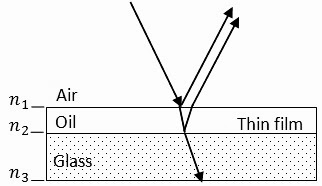
Blue light of wavelength 480 nanometers is most strongly reflected off a thin film of oil on a glass slide when viewed near normal incidence. Assuming that the index of refraction of the oil is 1.2 and that of the glass is 1.6, what is the minimum thickness of the oil film (other than zero)?

A. 150 nm
B. 200 nm
C. 300 nm
D. 400 nm
E. 480 nm
(GR0177 #69)
Solution:

n= 1
n= 1.2
n= 1.6

n n→ Δa λ/2
n n→ Δb = 2tλ/2

The Relative Shift:
Δ = Δb − Δa = 2t + λ/2 − λ/2 = 2t

For Constructive Interference: Δ =
For Destructive Interference: Δ = (m + ½)λ
with m = 0, 1, 2, 3, ...

Blue Light → Constructive interference, Δ = 

Δ =  = 2t
/2

λ 480 nm
m = 1 for minimum thickness other than 0,

t = 480/2 = 240 nm

Answer: B


Notes: Click HERE for more info on Thin Film.