Showing posts with label Radioactive. Show all posts

Nuclear & Particle Physics - Radioactive


A radioactive nucleus decays, with the activity shown in the graph above. The half-life of the nucleus is

A. 2 min
B. 7 min
C. 11 min
D. 18 min
E. 23 min
(GR9277 #26)
Solution:

From the graph: at t = 0, N ≈ 6 × 103

Half life, N½ = 3 × 103 → t = 7

Answer: B

Nuclear & Particle Physics - Uranium Decay

A uranium nucleus decays at rest into a thorium nucleus and a helium nucleus, as shown above. Which of the following is true?

A. Each decay product has the same kinetic energy.
B. Each decay product has the same speed.
C. The decay products tend to go in the same direction.
D. The thorium nucleus has more momentum than the helium nucleus.
E. The helium nucleus has more kinetic energy than the thorium nucleus.
(GR9277 #75)
Solution:

Conservation of momentum:
Uranium nucleus decays at rest:

C. FALSE


Thus, Helium has more momentum and kinetic energy than Thorium.
A, B, D are FALSE

Answer: E

Nuclear & Particle Physics - Radioactivity

Suppose that decays by natural radioactivity in two stages to . The two stages would most likely be which of the following?

First StageSecond Stage
A.      β emission with an antineutrino     α emission
B.β emissionα emission with a neutrino
C.β emissionγ emission
D.Emission of a deuteronEmission of two neutrons
E.α emissionγ emission
(GR9677 #30)
Solution:
→ First Stage → Second Stage →
by natural decay.

A. TRUE.
β decay:  emission of an electron and electron anti-neutrino,
α decay: emission of a Helium nucleus resulting in the loss of two protons and two neutrons,
Therefore,

B. FALSE.
β decay always emits an anti-neutrino
α decay does not emit neutrino

C. FALSE.
γ decay: photon emission with no change in mass number A or atomic number Z
Therefore,

D. FALSE.
Deuteron decay:
Deuteron (nucleus of deuterium) is a stable particle.
Deuteron decay is rare, not natural.

E. FALSE.

Answer: A

Nuclear & Particle Physics - Radioactive

An experimenter measures 9924 counts during one hour from a radioactive sample. From this number the counting rate of the sample can be estimated with a standard deviation of most nearly 

A. 100
B. 200
C. 300
D. 400
E. 500
(GR8677 #40)
Solution:

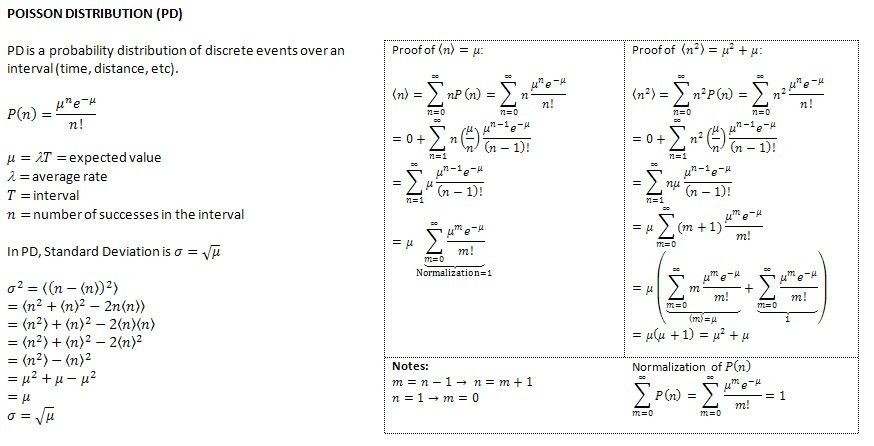
Radioactive decay can be described by Poisson Distribution.

Poisson Distribution (PD):
Probability distribution of discrete events over an interval (time. distance, etc)

In PD, Standard Deviation, σ μ (see Notes)
μ = expected number of events

Given: μ 9924 ≈ 10000
σ √10000 = 100

Answer: A


Notes: (click to enlarge)


Nuclear & Particle Physics - Gamma Rays Detector

An 8-cm diameter by 8-cm long NAI(TI) detector detects gamma rays of a specific energy from a point source of radioactivity. When the source is placed just next to the detector at the center of the circular face, 50 percents of all emitted gamma rays at that energy are detected. If the detector is moved to 1 meter away, the fraction of detected gamma rays drops to

A. 10−4
B. 2 ×10⁻⁴
C. 4 ×10⁻⁴
D. 8 ×10⁻⁴
E. 16 ×10−4
(GR0177 #14)
Solution:

The net power radiated by the source: P = I A
I = intensity
A = area of the surface

No power loss mentioned: P1 = P2
I1 A1 = I2 A2

A1 = area of circle with diameter 8 cm
r1  = 4 × 10⁻² m

A2 = area of sphere with radius 1 m

The problem asks for the fraction, not how much the intensity is detected.
Thus, the fraction is just the ratio of the areas:


Answer: C

Lab Methods - Uncertainty

A student makes 10 one-second measurement of the disintegration of a sample of a long lived radioactive isotope and obtains a following values: 3, 0, 2, 1, 2, 4, 0, 1, 2, 5. How long should the student count to establish the rate to an uncertainty of 1 percent?

A. 80 s
B. 160 s
C. 2000 s
D. 5000 s
E. 6400 s
(GR0177 #16)
Solution:

Radioactive decay can be described by Poisson Distribution.

Poisson Distribution (PD):
Probability distribution of discrete events over an interval (time. distance, etc)

In PD, Standard Deviation, σ = √μ  (see problem GR8677 #40)
μ = λT expected value
λ = average rate
= time interval

% Uncertainty = (σ/μ) × 100%

σ/μ = 0.01
μ/μ = 10−2
μ/μ2 = 10−4
1/μ = 1/104
μ = λT = 104

λ = (+ 0 + 2 + 1 + 2 + 4 + 0 + 1 + 2 + 5)/10 = 2
T = 104/2 = 5000

Answer: D

Nuclear & Particle Physics - Radioactive

A sample of radioactive nuclei of a certain element can decay only by -emission and -emission. If the half-life for -emission is 24 minutes and that for -emission is 36 minutes, the half-life for sample is

A. 30 minutes
B. 24 minutes
C. 20.8 minutes
D. 14.4 minutes
E. 6 minutes
(GR0177 #66)
Solution:

Total half-time for 2 or more processes:


For the sample with and emissions:


Answer: D

Nuclear & Particle Physics - Radioactive

When 74Be transforms into73Li, it does so by

A. emitting an alpha particle only
B. emitting an electron only
C. emitting a neutron only
D. emitting a positron only
E. electron capture by the nucleus with the emission of a neutrino

(GR0177 #68)
Solution:

The stable element Beryllium usually contains 4 protons and 5 neutrons in its nucleus.

However, there exists a lighter isotope of Beryllium, 47Be which contains 4 protons and only 3 neutrons, which give a total mass of 7 amu.

This lighter isotope decays into Lithium-7 through electron capture.

A proton from Beryllium-7 captures a single electron and becomes a neutron.

This reaction produces a new isotope (Lithium-7) that has the same atomic mass unit as Beryllium-7 but one less proton which stabilizes the element.

Answer: E