Showing posts with label Isothermal. Show all posts

Thermal Physics - Isothermal


Suppose one mole of an ideal gas undergoes the reversible cycle ABCA shown in the P-V diagram above, where AB is an isotherm. The molar heat capacities are Cp at constant pressure and Cv at constant volume. The net heat added to the gas during the cycle is equal to

A. RTh (V2/V1)
B. −Cp(Th − Tc)
C. Cp(Th − Tc)
D. RTh ln (V2/V1) − Cp(Th − Tc)
E. RTh ln (V2/V1) − R(Th − Tc)
(GR9677 #15)
Solution:

AB Isotherm → T Constant = Th

Ideal Gas: PV = nRT 
nRT / V

= 1 mole,

WAB = V1VP dV = RTh V1V(1/V) dV  = RTh ln (V2/V1)

BC Isobaric → P constant = P2

WBC = V2VP dV = P2 (V1− V2 P2V1   P2V2

From the diagram:
P2V1 = nRTc 
P2V2 = nRTh

WBC = nR(Tc − Th = R(Tc − Th)

WCA = 0  since V constant

Total W WAB WBC = RTh ln (V2/V1) + R(Tc − Th)

or

RTh ln (V2/V1) − R(Th − Tc)

Answer: E
Thermal Physic - Critical Isotherm

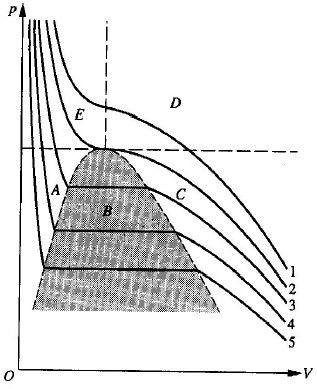
Questions 46-47.


Isotherms and coexistence curves are shown in the PV diagram above for a liquid-gas system. The dashed lines are the boundaries of the labeled regions. Which numbered curve is the critical isotherm? 

A. 1
B. 2
C. 3
D. 4
E. 5
(GR9277 #46)
Solution:

Critical isotherm (critical temperature) → dP/dV = 0
  • the derivative of the curve is zero
  • the tangent to the curve results in a horizontal line
  • the point where the vertical and horizontal dashed lines cross


Answer: B

Thermal Physics - Isothermal

A mole of ideal gas initially at temperature T0 and volume V0 undergoes a reversible isothermal expansion to volume V1. If the ratio of specific heats is cp/cv = γ and if R is the gas constant, the work done by the gas is

A. Zero
B. RT0 (V1/V0 )γ
C. RT0 (V1/V0 − 1)
D. cv T0 [1 − (V1/V0 )(γ−1)]
E. RT0 ln (V1/V0 )
(GR9277 #62)
Solution:

W = ∫ P dV

Ideal Gas: PV = nRT  → nRT / V

W = V0V1 nRT (1/V) dV

1 mole → n = 1
Isothermal, constant T0

→ W = RT0 V0V1 (1/V) dV RT0 ln (V1/V0 )

Answer: E  

Thermal Physics - Isothermal vs Adiabatic

An ideal monatomic gas expands quasi-statically to twice its volume. If the process is isothermal, the work done by the gas is Wi. If the process is adiabatic, the work done by the gas is Wa. Which is the following is true?

A. WWa
B. 0 = W W
C. 0  W W
D. 0 = W Wi
E.  W Wi
(GR0177 #06)
Solution:

Isothermal and Adiabatic P-V Diagram

  • Adiabatic connects high-T isotherm and low-T isotherm.
  • Isothermal line is always higher than the adiabatic line and they both end at the same volume
  • The area under the isothermal line is bigger than the adiabatic → W Wi
Answer: E

Calculation:

Isothermal:

PV = constant
PVi  PVf  = constant
Given Vf  = 2Vi
PVi  = 2PVi

P(iso) ½ Pi

Adiabatic:


PVγ c
PViγ PVγ = constant
Vf  = 2Vi
PiViγ  P(2Vi)γ = 2γPViγ 
P(adi) = (1/2γ)P
  
Therefore,

Pf (iso) /Pf (adi) = 2γ / 2
P(iso) = 2γ1Pf (adi)

→ Padi  Piso

W = ∫ PdV → Wadi  Wiso

Thermal Physics - Adiabatic Expansion

Consider the quasi-static adiabatic expansion of an ideal gas from an initial state i to a final state f. Which is the following statements is NOT true?

A. No heat flows into or out of the gas.
B. The entropy of state i equals the entropy of state f.
C. The change of internal energy of the gas is −∫ PdV.
D. The mechanical work done by the gas is ∫ PdV.
E. The temperature of the gas remains constant.
(GR0177 #36)
Solution:

A (not) dia (through) batic (passable) = no heat flow, container is well insulated
(A) and (B) are TRUE.

Q = 0
U = −W = −∫ PdV
(C) TRUE.

Definition of mechanical work: W = ∫ PdV
(D) TRUE.

T constant is Isothermal not adiabatic
(E) FALSE

Answer: E

Thermal Physics - Ideal Gas


A constant amount of an ideal gas undergoes the cyclic process ABCA in the PV diagram shown above. The path BC is isothermal. The work done by the gas during one complete cycle, beginning and ending at A, is most nearly

A. 600 kJ
B. 300 kJ
C. 0
D. −300 kJ
E. −600 kJ
(GR0177 #37)
Solution:

B-C Isotherm → T Constant
PV = constant
PBVB = PCVC

VB = PCVP= 500 × 2/200 = 5

The work done ≈ area of ∆CAB = ½ (CA × AB) = ½ [(500-200) × (5-2)] = 450.

Since BC is curved inside the ∆CAB, the work done is less than 450.
And, since the arrow is counterclockwise, the work done is negative.
Thus, the work done is less than −450

Answer: D


Complete calculation:

A-B Isobaric → P constant
W = PdV = 200(VB −  2)

C-A Isovolume → V constant
W = PdV = 0

B-C Isotherm → T constant
PV = constant
PBVB = PCVC
VB = PCVC/P = (500)(2)/(200) = 5

Wisobaric = 200(5 − 2) = 600

WisothermnRT ln(V/Vi )

For isotherm, PBVB = PCVC = nRT
Wisotherm = PBV ln(V/Vi )
= 200 × 5 × ln (2/5)
= 1000 (−0.916)
= −916

Wtotal = 600 − 916 = −316 kJ

Thermal Physics - Entropy

A sealed and thermally insulated container of total volume V is divided into two equal volumes by an impermeable wall. The left half of the container is initially occupied by n moles of a ideal gas at temperature T. Which of the following gives the change in entropy of the system when the wall is suddenly removed and the gas expands to fill the entire volume?

A. 2nR ln 2
B. nR ln 2
C. ½nR ln 2
D. -nR ln 2
E. -2nR ln 2
(GR0177 #47)
Solution:

The container is thermally insulated, dT = 0 or T constant → Isothermal expansion

Entropy for Isothermal expansion: S = Nk ln (Vf / Vi )

Since Vf = 2V→ S = Nk ln 2 = nR ln 2

Answer: B