Showing posts with label GR9277. Show all posts

Quantum Mechanics - Momentum Operator

The wave function of a particle is ei(kx−ωt) where x is distance, t is time, and k and are ω positive real numbers. The x–component of the momentum of the particle is 

A. 0
B. ħω
C. ħk
D. ħω/c
E. ħk/ω 
(GR9277 #01)
Solution: 

Momentum operator, p = −iħ∇

pψ = −iħ ∂ψ/∂x 
= −iħ ∂ei(kx−ωt)/∂x 
= ħk ei(kx−ωt) 
= ħkψ  

Answer: C 

Nuclear & Particle Physics - Bragg Diffraction

The longest wavelength X-ray that can undergo Bragg diffraction in a crystal for a given family of planes of spacing d is

A. d/4
B. d/2
C. d
D. 2d
E. 4d
(GR9277 #02)
Solution:

Bragg’s law: 2d sin θ = nλ

Maximum → sin θ = 1

and n = 1 (1st order)

λ = 2d

Answer: D

Nuclear & Particle Physics - X-rays

The ratio of the energies of the K characteristic X-rays of carbon (Z = 6) to those of magnesium (Z = 12) is most nearly

A. 1/4
B. 1/2
C. 1
D. 2
E. 4
(GR9277 #03)
Solution:
Moseley’s law:


K-series refers to a transition from some outer state, ni to the inner-most shell, nf = 1.
(The order from inner to outer → K, L, M, N).

→ E ≈ (Z − 1)2

Ecarbon = (6 − 1)2 = 25
Emagnesium = (12 − 1)2 = 121

The ratio = 25/121 ≈ 1/4

Answer: A

Classical Mechanics - Earth’s gravitational force

Questions 4-5

The magnitude of the Earth’s gravitational force on a point mass is F(r), where r is the distance from the Earth’s center to the point mass. Assume the Earth is a homogeneous sphere of radius R.

What is ? 

A. 32
B. 8
C. 4
D. 2
E. 1
(GR9277 #04)
Solution:

Gravity force: F = GMm/R2 → F ∝ 1/R2

F(R) ∝ 1/R2
F(2R) ∝ 1/4R2

F(R) / F(2R) = 4R2/ R2 = 4

Answer: C

Classical Mechanics - Gravitation

Questions 4-5

The magnitude of the Earth’s gravitational force on a point mass is F(r), where r is the distance from the Earth’s center to the point mass. Assume the Earth is a homogeneous sphere of radius R. 

Suppose there is a very small shaft in the Earth such that the point mass can be placed at a radius of R/2. What is ?

A. 8
B. 4
C. 2
D. 1/2
E. 1/4
(GR9277 #05)
Solution:

Newton's law of gravity becomes a linear law inside a body → F ∝ r
F(R) ∝ R
F(R/2) ∝ R/2


Answer: C

Classical Mechanics - Friction Force


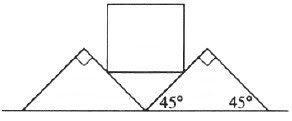
Two wedges, each of mass m, are placed next to each other on a flat floor. A cube of mass M is balanced on the wedges as shown above. Assume no friction between the cube and the wedges, but a coefficient of static friction between the wedges and the floor. What is the largest M that can be balanced as shown without motion of the wedges?

A.

B.

C.

D.

E. All M will balance
(GR9277 #06)
Solution:


Answer: D

Classical Mechanics - Pendulum


A cylindrical tube of mass M can slide on a horizontal wire. Two identical pendulum, each of mass m and length l, hang from the ends of the tube, as shown above. For small oscillations of the pendulums in the plane of the paper, the eigenfrequencies of the normal modes of oscillation of the system are 0,,   and …

A.

B.

C.

D.

E.
(GR9277 #07)
Solution:

2 modes in which the system can oscillate:

1. The 2 pendulum oscillate out of phase so there is torsional effect on the tube M → there is M in the equation.


2. In phase → no torsional effect on M → No M in the equation.


Answer: A


Classical Mechanics - Torque


A solid cone hangs from a frictionless pivot at the origin O as shown above. If î, ĵ and k̂ are unit vectors, and a, b, and c are positive constants, which of the following forces F applied to the rim of the cone at point P results in a torque τ on the cone with a negative component τz?

A. F = ak̂, P is (0, b, −c)
B. F = −ak̂, P is (0, −b, −c)
C. F = aĵ, P is (–b, 0, −c)
D. F = aĵ, P is (b, 0, −c)
E. F = −ak̂, P is (−b, 0, −c)
(GR9277 #08)
Solution:

Torque:
Result desired: negative component of τz so we are looking for minus k̂ component.

For k̂ component: rxFy − ryFx

Thus, Fx and Fy cannot be zero

(A) FALSE
 F = ak̂ → Fx = 0 and Fy = 0

(B) and (E) FALSE
F = −ak̂ → Fx = 0 and Fy = 0

(C) TRUE
F = aĵ → Fx = 0, Fy = a,  rx = −b, ry = 0,
P is (–b, 0, −c) → rx = −b, ry = 0
rxFy − ryFx = −ab − 0 =  −abk̂ (negative k̂ component)

(D) FALSE
F = aĵ → Fx = 0, Fy = a,
P is (b, 0, −c) → rx = b, ry = 0,
→ rxFy − ryFx = ab − 0 =  abk̂ (positive k̂ component)

Answer: C

Electromagnetism - Conductor


A coaxial cable having radii a, b, and c carries equal and opposite currents of magnitude i on the inner and outer conductors. What is the magnitude of the magnetic induction at point P outside of the cable at a distance r from the axis?

A. Zero

B.

C.

D.

E.
(GR9277 #09)
Solution:

The inner and outer conductors carry equal and opposite currents. Thus, the magnitude of the magnetic induction outside the coaxial cable is zero.

Answer: A 

Electromagnetism - Method of Image


Two positive charged of q and 2q coulombs are located on the x-axis at x = 0.5a and 1.5a respectively, as shown above. There is an infinite grounded conducting plane at x = 0. What is the magnitude of the net force on the charge q?

A. 

B. 

C. 

D. 

E. 
(GR9277 #10)
Solution:

Using method of image:


On q:


with  

Answer: E

Electromagnetism - Capacitor


The capacitor in the circuit shown above is initially charged. After closing the switch, how much time elapses until one-half of the capacitor’s initial stored energy is dissipated?

A. RC
B. RC/2
C. RC/4
D. RC ln 2
E. ½ RC ln 2
(GR9277 #11)
Solution:

Ut  = ½U0 , t = ?
Energy of capacitor:  U = ½CV2 

Ut  = ½U0 → ½CVt 2  = ½ × ½CV02
Vt 2  = ½ V02

Potential difference of capacitor: Vt = V0e−t/RC
Vt 2 = V02e−2t/RC
 ½ V02 = V02e−2t/RC → ½  = e−2t/RC
ln ½ = − 2t/RC →  ln 2 = 2t/RC 
t =  ½ RC ln 2

Answer: E

Electromagnetism - Electric Potential


Two large conducting plates form a wedge of angle α as shown-in the diagram above. The plates are insulated from each other; one has a potential V0 and the other is grounded. Assuming that the plates are large enough so that the potential difference between them is independent of the cylindrical coordinates z and ρ, the potential anywhere between the plates as s function of the angle φ is

A. V0/α
B. V0φ/α
C. V0α/φ
D. V0φ2/α
E. V0α/φ2
(GR9277 #12)
Solution:

Boundary conditions:
V(φ = 0) = 0 
V(φ = α) = V0 

(A) FALSE
V0/α does not depend on φ 

(B) TRUE
V0φ/α = 0 for φ = 0
V0φ/α = V0 for φ = α

(C) FALSE. V0α/φ = ∞ for φ = 0

(D) FALSE
For φ = α, V0φ2/α  = V0α 

(E) FALSE
For φ = α, V0φ2/α  = V0α

Answer: B

Electromagnetism - Maxwell's Equation

Listed below are Maxwell’s equations of electromagnetism. If magnetic monopoles exist, which of the these equations would be INCORRECT?

I. Curl H = J + ∂D/∂t
II. Curl E = −∂B/∂t
III. div D = ρ
IV. div B = 0

A. IV only
B. I and II
C. I and III
D. II and IV
E. III and IV
(GR9277 #13)
Solution:

Gauss' law of magnetism: ∇ · B = 0
→ There is no magnetic monopole
If there is one, ∇ · B ≠ 0

Faraday's law of induction: ∇ × E = −∂B/∂t
→ if there is magnetic monopole, ∇ × E = −∂B/∂t + (current of magnetic monopole)

Answer: D

Thermal Physics - Blackbody Radiation

The total energy of a blackbody radiation source is collected for one minute and used to heat water. The temperature of the water increases from 20.0oC to 20.5oC. If the absolute temperature of the blackbody is doubled and the experiment repeated, which of the following statements would be most nearly correct?

A. The temperature of the water would increase from 20oC to 21oC 
B. The temperature of the water would increase from 20oC to 24oC
C. The temperature of the water would increase from 20oC to 28oC
D. The temperature of the water would increase from 20oC to 36oC
E. The water would boil within the one-minute time period.
(GR9277 #14)
Solution:

Blackbody Radiation (Stefan-Boltzmann Law): u =  σT4  → u  ∝ T4
u1 ∝ T4 and u2 ∝ (2T)4

Heat Transfer: Q = mcΔT  → Q ∝ ΔT
Q1 ∝ ΔT1 = 20.5 − 20 = 0.5

u1/u2 = Q1/Q2 
T4/16T4  = 0.5/ΔT2 
ΔT2 = 16 × 0.5 = 8

Answer: C

Thermal Physics - Heat Capacity


A Classical model of a diatomic molecule is a springy dumbbell, as shown above, where the dumbbell is free to rotate about axes perpendicular to the spring. In the limit of high temperature, what is the specific heat per mole at constant volume?

A. 3/2 R
B. 5/2 R
C. 7/2 R
D. 9/2 R
E. 11/2 R
(GR9277 #15) 
Solution:

CV  for diatomic gas: CV  = CVtrans  + CVrot  + CVvib

At high T, all components contribute and each degree of freedom (DoF) contributes ½R to CV .

DoF trans = 3 (since it's 3 dimension)
DoF rot = 2 (diatomic atom)
DoF vib = 2 (1 for kinetic energy + 1 potential energy)
→ 3 + 2 + 2 = 7 → 7 DoF contributes ⁷/₂R

Answer: C

Thermal Physics - Carnot Cycle

An engine absorbs heat at a temperature of 727oC and exhaust heat at a temperature of 527oC. If the engine operates at maximum possible efficiency, for 2000 joules of heat input the mount of work the engine performs is most nearly 

A. 400 J
B. 1450 J
C. 1600 J
D. 2000 J
E. 2760 J
(GR9277 #16)
Solution:

TH = 727oC = 727 + 273 = 1000 K
TC = 527oC = 527 + 273 = 800 K
QH = 2000 J
W = ?

Efficiency of heat engine cycle: η = W/QH

Carnot efficiency: η = (TH − TC) /TH = 1 − TC/TH

W/QH = 1 − TC/TH
W = QH (1 − TC/TH) =  2000  (1 − 800/1000) = 400 J

Answer: A 

Lab Methods - Oscilloscope

The outputs of two electrical oscillators are compared on an oscilloscope screen. The oscilloscope spot is initially at the center of the screen. Oscillator Y is connected to the vertical terminals of the oscilloscope and oscillator X to the horizontal terminals. Which of the following patterns could appear on the oscilloscope screen, if the frequency of oscillator Y is twice that of oscillator X?


(GR9277 #17)
Solution:

→

Answer:

Electromagnetism - Impedance

In transmitting high frequency signals on a coaxial cable, it is important that the cable be terminated at an end with its characteristic impedance in order to avoid

A. Leakage of the signal out of the cable
B. Overheating of the cable
C. Reflection of signals from the terminated end of the cable
D. Attenuation of the signal propagating in the cable
E. Production of image currents in the outer conductors
(GR9277 #18)
Solution:

Characteristic impedance of a transmission line is the ratio of the voltage and current of a wave travelling along the line.

When the wave reaches the end of the line, a reflected wave could travels back in the opposite direction. It could develop an interference and cause the voltage to fluctuates.

To avoid this problem, the receiving end of a coaxial cable should be terminated using a resistance value equals to its characteristic impedance.

Answer: C

Classical Mechanics - Gravitation

Which of the following is most nearly the mass of the Earth? (The radius of the Earth is about 6.4 × 10⁶ m)

A. 6 × 1024 kg
B. 6 × 1027 kg
C. 6 × 1030 kg
D. 6 × 1033 kg
E. 6 × 1036 kg
(GR9277 #19)
Solution:

F =  mg = GMm/r2
M = gr2/G
M = 9.8 × (6.4 × 106)2 / (6.67 × 10⁻¹¹)
≈ 10 × 6 × 1012+11  
= 6 × 1024

Answer: A

Optics - Interference


In a double-slit interference experiment, d is the distance between the centers of the slits and w is the width of each slit, as shown in the figure above. For incident plane waves, an interference maximum on a distant screen will be “missing” when

A. d = √2 w
B. d = √3 w
C. 2d = w
D. 2d = 3w
E. 3d = 2w
(GR9277 #20)
Solution:

For double-slit interference, d is always bigger than w
→ (C) and (E) are FALSE

Constructive or destructive patterns of interference (single or double slits) only deals with integer and half integer factors.
→ (A) and (B) are FALSE

Answer: D


Calculation:

“missing” = destructive pattern (minimum intensity).
For double slit: d sin θ = (m + 1/2) λ; m = 0, 1, 2, 3, ...
For single slit: w sin θ = mλ; m = 1, 2, 3, ...

d/w =  (m + 1/2)/m
Take m = 1,
d/w = 3/2
2d = 3w