Showing posts with label My Favorite. Show all posts

Electromagnetism - Surface Charge Density

A point charge –q coulombs is placed at a distance d from a large grounded conducting plane. The surface charge density on the plane a distance D from the point charge is

A. q/4πD
B. (qD²)/2π
C. qd/(2πD²)
D. qd/(2πD³)
E. qd/(4πϵ0D²)
(GR8677 #63)
Solution:

dq = σdA

The unit for surface charge density  σ = coulomb/meter²

A. q/4πD → unit = coulomb/meter → FALSE
B. (qD²)/2π → unit = coulomb meter² → FALSE
C. qd/(2πD²) →unit = coulomb/meter → FALSE
D. qd/(2πD³) → unit = coulomb/meter² → TRUE
E. qd/(4πϵ0D²) → unit = coulomb/meter → FALSE

Answer: D

Note: click HERE for complete calculation.

Electromagnetism - Biot Savart's Law

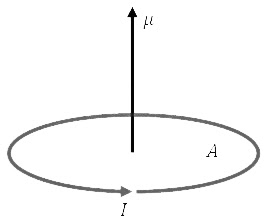
A current i in a circular loop of radius b produces a magnetic field. At a fixed points far from the loop, the strength of the magnetic field is proportional to which of the following combinations of i and b?

A. ib
B. ib² 
C. i²b
D. i/b
E. i/b² 
(GR8677 #65)
Solution:

Applying the concept of magnetic dipole moment:
μ =  a vector quantity associated with the torque exerted by an external magnetic field on a current carrying coil

μ = IA = Iπr² = iπb²
Answer: B

Note: click HERE for complete calculation to show that magnetic field at a fixed distance x far away from a circular loop:

Thermal Physics - Maxwell-Boltzmann Statistics

A large isolated of N weakly interacting particles is in thermal equilibrium. Each particle has only 3 possible non degenerate states of energies 0, ε, and 3ε. When the system is at an absolute temperature T ≫ ε/k, where k is Boltzmann’s constant, the average energy of each particle is

A. 0
B. ε
C. 4ε /3
D. 2ε
E. 3ε
(GR8677 #67)
Solution:

In thermal equilibrium:
→ Each particle has roughly equal probability of being in any of the three states.
→ The average energy of each particle is total energy/3 = (0+ε+3ε)/3 = 4ε/3

Answer: C

Note:

Complete Calculation:

T ≫ ε/k → 1 ≫ ε/kT 
ε/kT → 0
e-ε/kT → e0  = 1

Partition function: Z = ∑i e-εi/kT
i = 3 → Z = 3

Probability: Pi = e-εi/kT/Z
→ P1 = P2  = P3  = 1/3

Energy: E = ∑i EiPi
→ E = E1P1 + E2P2 + E3P3 = (0+ε+3ε)/3 = 4ε/3

Thermal Physics - Maxwell-Boltzmann Statistics

Consider a system of N non-interacting particles confined in a volume V at a temperature such that the particles obey classical Boltzmann statistics. If the temperature is lowered to the point at which quantum effects become important, the pressure of the gas may differ depending on whether the particles are fermions or bosons. Let PF be the pressure exerted by the particles if they are fermions. PB be the pressure if they are bosons and, and PC be the pressure the particles would exert if quantum effects are ignored. Which of the following is true?

A.
B.
C.
D.
E.
(GR8677 #88)
Solution:

Ideal gas:

Classical (Maxwell-Boltzmann Statistics):


For Bosons (photon):


→

For Fermion:
= Fermi Energy,

For the same temperature:  

Answer: B