Showing posts with label #81. Show all posts

Sound and Wave - Beats and Tunning

A piano tuner who wishes to tune the note Dcorresponding to a frequency of 73.416 hertz has tuned A to a frequency of 440.000 hertz. Which harmonic of D(counting the fundamental as the first harmonic) will give the lowest number of beats per second, and approximately how many beats will this be when the two notes are tuned properly?


Harmonic
Number of Beats
A.   
6

5
B.
6

0.5
C.
5

0.1
D.
3

0.372
E.       
2
       
4.5
(GR9677 #81)
Solution:

Beats are the alternating constructive and destructive interference produced when two sound waves of different frequency approaching our ear. If there is no difference in frequency, there will be no beats. To minimize or to get the lowest number of beats, we set the beat frequency to zero.

440.000  73.4160
 440/73 ≈ 6

Number of beats = |440.000  (73.416)(6)|  = |440.000  440.496| =  0.496 ≈ 0.5

Answer: B 

Electromagnetism - RLC Circuit


In the RLC circuit shown, the applied voltage is ε(t) = εm cos ωt For a constant εm, at what angular frequency ω does the current have its maximum steady-state amplitude after the transients have died out?

A. 1/RC
B. 2L/R
C. 1/√(LC)
D. √[(1/LC) − (R/2L)²]
E.  √[(1/RC)² − (L/R)²]
(GR9277 #81)
Solution:

Imax when XL = XC

→ ωL = 1 / ωC

ω = 1/√(LC)

Answer: C

Electromagnetism - Faraday’s law


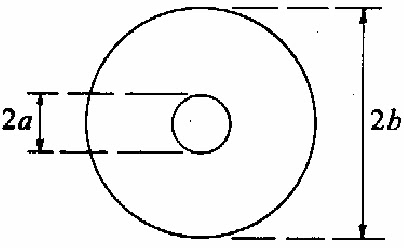
A small circular wire loop of radius a is located at the center of a much larger circular wire loop radius b as shown above. The larger loop carries an alternating current I = I0 cos ωt, where I0 and ω are constants. The magnetic field generated by the current in the large loop induces in the small loop an emf that is approximately equal to which of the following? (Either use mks units and let μ0 be the permeability of free space, or use Gaussian units and let μ0 be 4π/c².)

A.
B.
C.
D.
E.
(GR8677 #81)
Solution:

Faraday's Law: ɛ = − dΦ/dt
with  Φ = NBA  

Biot Savart Law: B ~ I

Given:
I = I0 cos ωt → B ~ I0 cos ωt
Area of smaller loop with radius a, A = πa²
N = 1

Φ = BA ≈ πa² I0 cos ωt
ɛ ~ dΦ/dt πa² ω I0 sin ωt

Only (B) fits the equation.

Answer: B


Complete Calculation:

Faraday's Law: ɛ = − dΦ/dt
with  Φ = NBA  

Magnetic field at the center of a current wire loop:  (Proof)
For the larger loop with radius b, carrying I = I0 cos ωt →

Area of smaller loop with radius aA = πa²

N = 1