Showing posts with label #29. Show all posts

Quantum Mechanics - Planck Length

The characteristic distance at which quantum gravitational effects are significant, the Planck length can be determined from a suitable combination of the physical constants Għ, and c. Which of the following correctly gives the Planck length?

A. Għc
B. Għ2c3
C. G2ħc
D. G½ħ2c
E. (Għ/c3)½
(GR9677 #29)
Solution:

Check units:

Let's l Planck length
 Għcz

G unit = m3 kg−1 s2
ħ unit = Js = Nms = kg m2 s−1
c unit = m s−1
l unit = m

m = (m3 kg−1 s2)x  (kg m2 s−1)(m s−1)z

For m:
1 = 3x + 2y + z

For kg:
0 = − x + y
x = y

For s:
0 = − 2x − y − z
0 = − 3x − z
z = − 3x

1 = 3x + 2y + z 
1 = 3x + 2x − 3x = 2x
x = y = 1/2
z = − 3x = − 3/2

Għc
G1/2 ħ1/2 c−3/2
= (Għ/c3)½

Answer: E

Quantum Mechanics, Particle in a box


An attractive, one-dimensional square well has depth V0 as shown above. Which of the following best shows a possible wave function for a bound state?


(GR9277 #29)
Solution:

1-D square well with depth  V0  → finite potential well.

Wave function of a particle in finite potential well should have these following properties:

  • ψ →0 as x → ± ∞ or get further into regions where the classical particle cannot penetrate at all due to its inadequate energy
  • ψ is always a decaying exponential function
  • ψ must be continuous and differentiable

Therefore:

A. FALSE. ψ does not go to zero as x → ±∞

C. FALSE. ψ is not continuous

D and E are FALSE. ψ are not decaying exponential functions

Answer: B

Electromagnetism - Lorentz Force

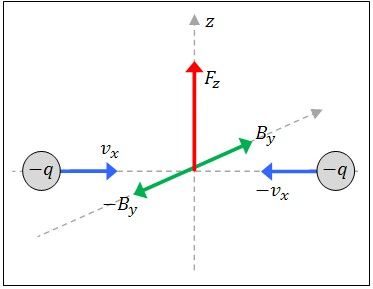
A negative test charge is moving near a long straight wire in which there is a current. A force will act on the test charge in a direction parallel to the direction of the current if the motion of the charge is in a direction

A. Toward the wire
B. Away from the wire
C. The same as that of the current
D. Opposite to that of the current
E. Perpendicular to both the direction of the current and the direction toward the wire
(GR8677 #29)
Solution:

Right Hand Rule #1
 
In this case, the force is parallel to the current,
 
Lorentz Force:

Right hand rule #2:
 

→ For positive charge:

→ For negative charge:
 

Therefore, the motion of the charge is in a direction toward the wire:

 
Answer: A


Alternative Solution:


Let the current points upwards along the page →
From the left side of the current, magnetic field is coming out of the page → 
From the right side of the current, magnetic field is going into the page → 

Lorentz Force:
Negative test charge →
If force parallel to current →
Magnetic field (on the right side) → 
Direction of ?


Using the same method, from left side:

Quantum Mechanics - Expectation Value

The state   is linear combination of three orthonormal eigenstates of the operator corresponding to eigenvalues -1,1 and 2. What is the expectation value of    for this state?

A. 2/3
B. √(7/6)
C. 1
D. 4/3
E. (√3+2√2-1)/√6
(GR0177 #29)
Solution:

The expectation value:


Answer: C