Showing posts with label Thermal Physics. Show all posts

Thermal Physics - Power

A 100-watt electric heater element is placed in a pan containing one liter of water. Although the heating element is on for a long time, the water, though close to boiling does not boil. When the heating element is removed, approximately how long will it take the water to cool by 1 degree Celsius? (Assume that the specific heat for water is 4.2 kJ/kgoC)

A. 20 s
B. 40 s
C. 60 s
D. 130 s
E. 200 s
(GR9677 #13)
Solution:

P = 100 W
V = 1 L = 1 m3 → m = 1 kg (STP)
Δ1oC
c = 4.2 kJ/kgoC

Q = mcΔT = Pt
1 × 4200 × 1 = 100t
t = 42 s

Answer: B

Thermal Physics - Specific Heat

Two identical 1 kg blocks of copper metal one initially at a temperature T= 0oC and the other initially at a temperature T= 100oC are enclosed in a perfectly insulating container. The two blocks are initially separated. When the blocks are placed in contact, they come to equilibrium at a final temperature Tf. The amount of heat exchanged between the two blocks in this process is equal to which of the following? (The specific heat of copper metal is equal to 0.1 kilocalorie/kgoK)

A. 50 Kcal
B. 25 Kcal
C. 10 Kcal
D. 5 Kcal
E. 1 Kcal
(GR9677 #14)
Solution:

mcΔT
|Q|gain = |Q|lost 
m1c1ΔT1  = m2c2ΔT2

m1 = m= 1 kg
ccccopper = 0.1 kcal/kgoK
T= 0oC = 273oK
T= 100oC = 373oK

ΔT1 = ΔT2
Tf   − TT− T
T = (TT1)/2 = (100 + 0)/2 = 50o= 323oK

|Q|gain = |Q|lost  = m1c1ΔT1  = 1 × 0.1 × (323 − 273) = 5kcal

Answer: D

Thermal Physics - Isothermal


Suppose one mole of an ideal gas undergoes the reversible cycle ABCA shown in the P-V diagram above, where AB is an isotherm. The molar heat capacities are Cp at constant pressure and Cv at constant volume. The net heat added to the gas during the cycle is equal to

A. RTh (V2/V1)
B. −Cp(Th − Tc)
C. Cp(Th − Tc)
D. RTh ln (V2/V1) − Cp(Th − Tc)
E. RTh ln (V2/V1) − R(Th − Tc)
(GR9677 #15)
Solution:

AB Isotherm → T Constant = Th

Ideal Gas: PV = nRT 
nRT / V

= 1 mole,

WAB = V1VP dV = RTh V1V(1/V) dV  = RTh ln (V2/V1)

BC Isobaric → P constant = P2

WBC = V2VP dV = P2 (V1− V2 P2V1   P2V2

From the diagram:
P2V1 = nRTc 
P2V2 = nRTh

WBC = nR(Tc − Th = R(Tc − Th)

WCA = 0  since V constant

Total W WAB WBC = RTh ln (V2/V1) + R(Tc − Th)

or

RTh ln (V2/V1) − R(Th − Tc)

Answer: E

Thermal Physics - Mean Free Path

The mean free path for the molecules of a gas is approximately given by 1/ησ, where η is the number density and σ is the collision cross section. The mean free path for air molecules at room conditions is approximately

A. 10−4 m
B. 10−7 m
C. 10−10 m
D. 10−13 m
E. 10−16 m
(GR9677 #16)
Solution:

Mean free path = 1/ησ

Number density, η = N/V  
Cross section area, σ = πr2 

For Ideal Gas: PV = NkT

1/ησ = Nπr NkT / PNπrkT Pπr  

= 1.38 × 10−2Joule/K
Radius of atom is in order of Angstrom: 10−10 m
P (STP) = 1 atm = 105 Newton/meter2
T (STP) = 0 °C = 32 °F = 273.15 K ≈ 2 × 10K

kT Pπr= (1.38 × 10−2× 2 ×102) / (π ×10× 10−20) 
(1.38 × 2 / π10−23+25+20 ≈ 10−7

Answer: B

Thermal Physics - Adiabatic

The adiabatic expansion of an ideal gas is described by the equation PV γ = C, where γ and C are constants. The work done by the gas is expanding adiabatically from the state (ViPi) to (VfPf) is equal to

A. PfVf
B. ½(Pi + Pf)(V − Vi)
C. (PfVf   − PfVi)/(1 − γ)
D. Pi(Vf 1+ γ − V1+ γ )/(1 + γ)
E. P(V1- γ − V1- γ)/(1 + γ)
(GR9677 #73)
Solution:

PV γ C
P CV γ

W = ∫ P dV
C ViVf  V γ dV
= [C/(−γ + 1)] V γ+1 Vi|Vf
= [C/(1 − γ)] (Vf 1γ− Vi 1γ)
= (VfCVf γ− Vi CVi 1γ)/(1 − γ)
= (VfPf  − Vi Pi )/(1 − γ)
= (PfVf  − PiVi )/(1 − γ)

Answer: C

Thermal Physics - Entropy

A body of mass m with spesific heat C at temperature 500 K is brought into contact with an identical body at temperature 100 K, and the two are isolated from their surroundings. The change in entropy of the system is equal to

A. ⁴⁄₃ mC
B. mC ln  ⁹⁄₅
C. mC ln 3
D. –mC ln ⁵⁄₃
E. 0
(GR9677 #74)
Solution:

Entropy:


m= m= m
ccC
T= 500
T= 100
Tf = (500 + 100)/2 = 300


Answer: B

Thermal Physics - Thermal Conductivities


Window A is a pane of glass 4 millimeters thick, as shown above. Window B is a sandwich consisting of two extremely thin layers of glass separates by an air gap 2 millimeters thick, as shown above. If the thermal conductivities of glass and air are 0.8 watt/meter Window A is a pane of glass 4 millimeters thick, as shown above. Window B is a sandwich consisting of two extremely thin layers of glass separated by an air gap 2 millimeters thick, as shown above. If the thermal conductivities of glass and air are 0.8 watt/meter oC and 0.025 watt/meter oC, respectively, then the ratio of the heat flow through window A to the heat flow through window B is.

A. 2
B. 4
C. 8
D. 16
E. 32
(GR9677 #75)
Solution:

The thicker the glass, the harder for heat to flow → q ∼ 1/t

Thermal conductivity, κ: property of material that allows the flow of heat through the material. 

Higher κ → higher the flow of heat → q ∼ κ
q ∼ κ/t
qq= (κA dA )( dB κB) =  (0.8 / 4)(2 /0.025)  =  16

Answer: D

Note:

Fourier's Law of Heat Conduction: q = − κ  = − κ dT/dx

= − κ dT/dx (in 1-D),
T = temperature,  
dx  = length or thickness, t

q ∼ κ/t

Thermal Physics - Heat Capacity

For an ideal diatomic gas in thermal equilibrium, the ratio of the molar heat capacity at constant volume at very high temperatures to that at very low temperatures is equal to

A. 1
B. 5/3
C. 2
D. 7/3
E. 3
(GR9677 #79)
Solution:

CV  for diatomic gas: CV  = CVtrans + CVrot  + CVvib

For very low T, only translational component contributes
→ CV(T) = 3/₂ Nk

For very high T, all 3 components (translational, vibrational, rotational) contribute
→ CV(T) = (3/₂ + 1 + 1) R = ⁷/₂ Nk

Ratio CV(T) / CV(T)  = 7/3

Answer: D

Thermal Physics - Blackbody Radiation

The total energy of a blackbody radiation source is collected for one minute and used to heat water. The temperature of the water increases from 20.0oC to 20.5oC. If the absolute temperature of the blackbody is doubled and the experiment repeated, which of the following statements would be most nearly correct?

A. The temperature of the water would increase from 20oC to 21oC 
B. The temperature of the water would increase from 20oC to 24oC
C. The temperature of the water would increase from 20oC to 28oC
D. The temperature of the water would increase from 20oC to 36oC
E. The water would boil within the one-minute time period.
(GR9277 #14)
Solution:

Blackbody Radiation (Stefan-Boltzmann Law): u =  σT4  → u  ∝ T4
u∝ T4 and u∝ (2T)4

Heat Transfer: Q = mcΔT  → ∝ ΔT
Q∝ ΔT1 = 20.5 − 20 = 0.5

u1/uQ1/Q
T4/16T4  = 0.5/ΔT
ΔT= 16 × 0.5 = 8

Answer: C

Thermal Physics - Heat Capacity


A Classical model of a diatomic molecule is a springy dumbbell, as shown above, where the dumbbell is free to rotate about axes perpendicular to the spring. In the limit of high temperature, what is the specific heat per mole at constant volume?

A. 3/2 R
B. 5/2 R
C. 7/2 R
D. 9/2 R
E. 11/2 R
(GR9277 #15) 
Solution:

CV  for diatomic gas: CV  = CVtrans  + CVrot  + CVvib

At high T, all components contribute and each degree of freedom (DoF) contributes ½R to CV .

DoF trans = 3 (since it's 3 dimension)
DoF rot = 2 (diatomic atom)
DoF vib = 2 (1 for kinetic energy + 1 potential energy)
→ 3 + 2 + 2 = 7 → 7 DoF contributes ⁷/₂R

Answer: C

Thermal Physics - Carnot Cycle

An engine absorbs heat at a temperature of 727oC and exhaust heat at a temperature of 527oC. If the engine operates at maximum possible efficiency, for 2000 joules of heat input the mount of work the engine performs is most nearly 

A. 400 J
B. 1450 J
C. 1600 J
D. 2000 J
E. 2760 J
(GR9277 #16)
Solution:

T727oC = 727 + 273 = 1000 K
T527oC = 527 + 273 = 800 K
Q= 2000 J
W = ?

Efficiency of heat engine cycle: η = W/QH

Carnot efficiency: η = (T− TC/T= 1  TC/TH

W/Q= 1  TC/TH
W Q( TC/TH) =  2000  ( 800/1000) = 400 J

Answer: A 

Thermal Physics - Conduction Electron

The Fermi temperature of Cu is about 80,000 K. Which of the following is most nearly equal to the average speed of a conduction electron in Cu? 

A. 2 × 10⁻² m/s
B. 2 m/s
C. 2 × 10² m/s
D. 2 × 10⁴ m/s
E. 2 × 10⁶ m/s
(GR9277 #23)
Solution:

TF = 8 × 10⁴ K
me = 9.11 × 10⁻³¹ kg
k = 1.38 × 10−23 J/K

Fermi energy = Kinetic energy


Answer: E

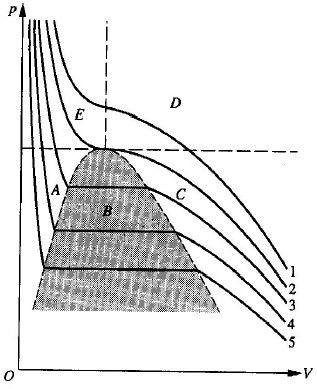
Thermal Physic - Critical Isotherm

Questions 46-47.


Isotherms and coexistence curves are shown in the PV diagram above for a liquid-gas system. The dashed lines are the boundaries of the labeled regions. Which numbered curve is the critical isotherm? 

A. 1
B. 2
C. 3
D. 4
E. 5
(GR9277 #46)
Solution:

Critical isotherm (critical temperature) → dP/dV = 0
  • the derivative of the curve is zero
  • the tangent to the curve results in a horizontal line
  • the point where the vertical and horizontal dashed lines cross


Answer: B

Thermal Physics - Thermal Equilibrium

See Problem #46

In which region are the liquid and the vapor in equilibrium with each other?

A. A
B. B
C. C
D. D
E. E
(GR9277 #47)
Solution:

Region A: V small  → Liquid
Region E: P large, V small → Liquid
Region D and C: V large →  Gas
Phase equilibrium exists only if the temperature of isotherm lies below critical temperature.

Answer: B

Thermal Physics - Isothermal

A mole of ideal gas initially at temperature T0 and volume V0 undergoes a reversible isothermal expansion to volume V1. If the ratio of specific heats is cp/cv = γ and if R is the gas constant, the work done by the gas is

A. Zero
B. RT0 (V1/V0 )γ
C. RT0 (V1/V0 − 1)
D. cv T0 [1 − (V1/V0 )(γ−1)]
E. RT0 ln (V1/V0 )
(GR9277 #62)
Solution:

W = ∫ P dV

Ideal Gas: PV = nRT  → nRT / V

W = V0V1 nRT (1/V) dV

1 mole → n = 1
Isothermal, constant T0

→ W = RT0 V0V1 (1/V) dV RT0 ln (V1/V0 )

Answer: E  

Thermal Physics - Probability

Which of the following is true if the arrangement of an isolated thermodynamic system is of maximal probability?

A. Spontaneous change to a lower probability occurs
B. The entropy is minimum
C. Botzmann’s constant approaches zero
D. No spontaneous change occurs
E. The entropy is zero
(GR9277 #63)
Solution:

Maximal Probability → highest/maximum entropy → most stable state /equilibrium → No spontaneous change occurs. Spontaneous change occurs when the system is far from equilibrium.

Answer: D

Thermal Physics - Fermi-Dirac Statistics

Questions 71-73

A system in thermal equilibrium at temperature T consists of a large number N0 of subsystems, each of which can exist only in two states of energy E1 and E2, where . In the expressions that follow, k is the Boltzmann constant.

For a system at temperature T, the average number of subsystems in the state of energy E1 is given by

A. 

B. 

C.

D.

E.
(GR9277 #71)
Solution:

For only 2 states of energy → Fermi-Dirac distribution

Number of states: 

Since , take E2 = 2ϵ and E1 = ϵ

For E1 = ϵ, number of states:

Answer: B

Thermal Physics - Heat Capacity

Questions 71-73

A system in thermal equilibrium at temperature T consists of a large number N0 of subsystems, each of which can exist only in two states of energy E1 and E2, where . In the expressions that follow, k is the Boltzmann constant.

The internal energy of this system at any temperature T is given by . The heat capacity of the system is given by which of the following expressions?

A.

B.

C.

D.

E.
(GR9277 #72)
Solution:

Heat Capacity (at constant  volume), 


Answer: A

Thermal Physics - Entropy

Questions 71-73

A system in thermal equilibrium at temperature T consists of a large number N0 of subsystems, each of which can exist only in two states of energy E1 and E2, where . In the expressions that follow, k is the Boltzmann constant.

Which of the following is true of entropy of the systems?

A. It increases without limit with T from zero at T = 0
B. It decreases with increasing T
C. It increases from zero at T = 0 to N0k ln 2 at arbitrarily high temperature
D. It is given by N0k [5/2 ln T − ln p + constant]
E. It cannot be calculated from the information given
(GR9277 #73)
Solution:

At low T, entropy S(T → 0) = 0
At high T, S = kσ

σ = ln (number of states with the same total energy)

For 2  states of energy, σ = ln 2
S = k ln 2

For N0 subsystems.
S = N0k ln 2

Answer: C

Thermal Physics - Specific Heat

For an ideal gas, the specific heat at constant pressure Cp is greater than the specific heat at constant volume Cv because the
  1. Gas does work on its environment when its pressure remains constant while its temperature is increased.
  2. Heat input per degree increase in temperature is the same in processes for which either the pressure or the volume is kept constant.
  3. Pressure of the gas remains constant when its temperature remains constant.
  4. Increase in the gas’s internal energy is greater when the pressure remains constant than when the volume remains constant
  5. Heat needed is greater when the volume remains constant than when the pressure remains constant.
(GR8677 #14)
Solution:

(A) TRUE.
Heat Capacity: C = Q/dT

First law of Thermodynamics: the change in internal energy of a system dU is equal to the heat Q added and the work, W done on or by the system 
dUQ ± W

W done on the system → +W
W done by the system → −W

Gas (the system) does work on its environment
W done by the system
dU = Q − W

At constant V:
Work, = PdV = 0
Q = dU
CvdU/dT

At constant P:
Work, PdV ≠ 0
Q = dU + W
Cp = dU/dT + PdV/dT = CvPdV/dT
Cp  Cv

(B) FALSE.
This means Cp = Cv, but according to A, Cp  Cv

(C) FALSE.
Ideal gas law: PV = NkT
If T constant, P changes if V changes.

(D) FALSE.
Heat Capacity, C = Q/dT does not depend on the gas’ internal energy, U

(E) FALSE.
See A. At constant V, Q = dU.
At constant PQ = dU + W.

Answer: A