Showing posts with label Lorentz Force. Show all posts

Electromagnetism - Electric and Magnetic Force

A positively charged particle is moving in the xy-plane in a region where there is a non-zero uniform electric magnetic field B in the +z –direction and a non-zero uniform electric field in the +y-direction. Which of the following is a posible trajectory for the particle?


(GR9677 #86)
Solution:

v is in the xy-plane
E is in +y-direction


F is in +y-direction
→ particle will be deflected by E in +y-direction

B is in +z-direction


F,v, B orthogonal to each other
E and B orthogonal to each other

Particle moving in an orthogonal direction with B will exhibit cyclotron (helix shaped motion).                    
Answer:  B

Electromagnetism - Cyclotron

An electron in a metal has an effective mass m* = 0.1 me. If this metal is placed in a magnetic field of magnitude 1 tesla, the cyclotron resonance frequency ωc, is most nearly

A. 930 rad/s
B. 8.5 × 10⁶ rad/s
C. 2.8 × 10¹¹ rad/s
D. 1.8 × 10¹² rad/s
E. 7.7 × 10²⁰ rad/s
(GR9277 #60)
Solution:


Angular velocity: 


Answer: D

Electromagnetism - Electric and Magnetic Forces

A charge particle is released from rest in a region where there is a constant electric field and a constant magnetic field. If the two fields are parallel to each other, the path of the particle is a

A. circle
B. parabola
C. helix
D. cycloid
E. straight line
(GR8677 #25)
Solution:


Electric Force:
→ the path of the particle is parallel to the electric field.
→ the velocity of particle has the same direction with the electric field.

Magnetic Force/Lorentz Force:  

If
→ no magnetic field contribution
→ the path of the particle is a straight line, parallel to the electric field.

Answer: E

Electromagnetism - Lorentz Force

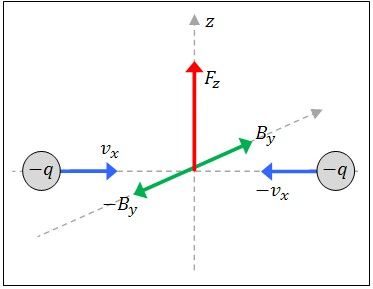
A negative test charge is moving near a long straight wire in which there is a current. A force will act on the test charge in a direction parallel to the direction of the current if the motion of the charge is in a direction

A. Toward the wire
B. Away from the wire
C. The same as that of the current
D. Opposite to that of the current
E. Perpendicular to both the direction of the current and the direction toward the wire
(GR8677 #29)
Solution:

Right Hand Rule #1
 
In this case, the force is parallel to the current,
 
Lorentz Force:

Right hand rule #2:
 

→ For positive charge:

→ For negative charge:
 

Therefore, the motion of the charge is in a direction toward the wire:

 
Answer: A


Alternative Solution:


Let the current points upwards along the page →
From the left side of the current, magnetic field is coming out of the page → 
From the right side of the current, magnetic field is going into the page → 

Lorentz Force:
Negative test charge →
If force parallel to current →
Magnetic field (on the right side) → 
Direction of ?


Using the same method, from left side:

Electromagnetism - Particle's Trajectory


A particle with charge q and momentum p is moving in the horizontal plane under the action of a uniform vertical magnetic field of magnitude B. Measurements are made of the particle's trajectory to determine the “sagitta” s and half-chord length l, as shown in the figure above. Which of the following expressions gives the particle's momentum in terms of q, B, s, and l? (Assume s l).

A. qBs2/2l
B. qBs2/l
C. qBl/s
D. qBl2/2s
E. qBl2/8s
(GR9677 #89)
Solution:


Answer: D

Electromagnetism - Lorentz Force

A proton moves in the +z direction after being accelerated from rest through a potential difference V. The proton then passes through a region with a uniform electric field E in the +x direction and a uniform magnetic field B in the +y direction, but the proton’s trajectory is not affected. If the experiment were repeated using a potential difference of 2V, the proton would then be

A. Deflected in the +x-direction
B. Deflected in the -x-direction
C. Deflected in the +y-direction
D. Deflected in the -y-direction
E. Undeflected
(GR0177 #58)
Solution:

Lorentz Force: 

Since it is not deflected, 

Potential energy transforms into kinetic energy, qV = ½ mv2

Thus, velocity is  

For 2V, velocity is  
  
Therefore,

Particle is deflected in −x direction

Answer: B


Electromagnetism - Cyclotron

A nonrelativistic particle with a charge twice that of an electron moves through a uniform magnetic field. The field has a strength of π/4 tesla and is perpendicular to the velocity of the particle. What is the particle’s mass if it has a cyclotron frequency of 1,600 hertz?

A. 2.5 × 10⁻²³ kg
B. 1.2 × 10⁻²² kg
C. 3.3 × 10⁻²² kg
D. 5.0 × 10⁻²¹ kg
E. 7.5 × 10⁻²¹ kg
(GR0177 #62)
Solution:


Angular velocity: 


Answer: A