Showing posts with label Generator. Show all posts

Electromagnetism - Electric Circuit


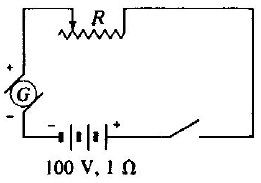
The battery in the diagram above is to be charged by the generator G. The generator has a terminal voltage of 120 volts when the charging current is 10 Amperes. The battery has an emf of 100 volts and an internal resistance of 1 Ohm. In order to charging current, the resistance R should be set at 

A. 0.1 Ω
B. 0.5 Ω
C. 1.0 Ω
D. 5.0 Ω
E. 10.0 Ω
(GR8677 # 24)
Solution:

Potential difference across the resistor R:
V = IRt = VGeneratorVBattery = 120 − 100 = 20 V
Total resistance:
Rt = R + Rinternal = R + 1
IRt = I(R + 1) = 10(R + 1) = 20 V
R = 1 Ω

Answer: C

Electromagnetism - Impedance

An alternating current electrical generator has a fixed internal impedance Rg + jXg and is used to supply power to a passive load that has an impedance Rg + jX1, where j =√(−1). Rg ≠ 0 and Xg ≠ 0. For a maximum power transfer between the generator and the load, X1 should be equal to

A. 0
B. Xg
C. −Xg
D. Rg
E. −Rg
(GR8677 #64)
Solution:

Maximum power transfer theorem (Impedance matching): 

Maximum power is transferred from a source to a load when

  • Load resistance = the internal resistance of the source, or 
  • Load impedance = complex conjugate source impedance (Zl Zs*)
Zs Rg + jXg  with  j =√(−1)
Zs* Rg  jXg

For max power transferred: 
Zl  Zs*
XXg

Answer: C