Showing posts with label Angular Frequency. Show all posts

Electromagnetism - Oscillation

Question 3-4: refer to a thin, nonconducting ring of radius R, as shown below, which has a charge Q uniformly spread out on it.


A small particle of mass m and charge –q is placed at point P and released. If R ≫ x, the particle will undergo oscillations along the axis of symmetry with an angular frequency that is equal to:


(GR9677 #04)

Solution:

Felectric = kqQ/r²
Fcentripetal = mv²/r = mω²r

FFc
kqQ/r² = mω²r
ω² = kqQ/mr³

with
= 1/4πɛ0
r²  = R² + x²
R ≫ x
r² ∼ R²  → r³ ∼ R³

ω = √(qQ/4πɛ0mR3)

Answer: A

Notes:
see problem GR9277 #65

Electromagnetism - Faraday’s law


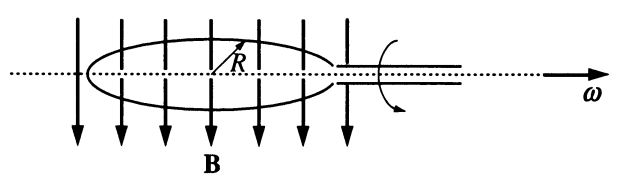
A circular wire loop of radius R rotates with an angular speed ω in a uniform magnetic field B, as shown in the figure. If the emf ɛ induced in the loop is ɛ0 sin ωt, then the angular speed of the loop is

A. ɛ0 R/B
B. 2πɛ0/R
C. ɛ0/BπR2
D. ɛ02/BR2
E. tan−1(ɛ0/Bc)
(GR9677 #46)
Solution:

Faraday's Law: ɛ = − dΦ/dt
with  Φ = NBA  

Given:
= 1
B uniform (constant)
ɛ =  ɛ0 sin ωt

→ ɛ = − B dA/dt =  ɛ0 sin ωt
− B dA =  ɛ0 sin ωdt 
 B ∫dA =  ɛ0 ∫ sin ωdt 
− BπR2 = − ɛ0/ω  cos ωt
ω = ɛcos ωt / BπR2

at t = 0,
ω ɛ/ BπR2

Answer: C


Alternative solution:
πR cos ωt
ɛ = − dΦ/dt = − B dA/dt 
ɛ = − BπR d(cos ωt)/dt 
ɛ0 sin ωt BπR2ω  sin ω
ɛ0BπR2ω  
ω ɛ/ (BπR2)

Classical Mechanics - Lagrangian


A bead is constrained to slide on a frictionless rod that is fixed at an angle θ with a vertical axis and is rotating with angular frequency ω about the axis, as shown above. Taking the distance s along the rod as the variable, the Lagrangian for the bead is equal to

A. ½ mṡ ² − mgs cos θ 
B. ½ mṡ ² + ½ m(ωs − mgs 
C. ½ mṡ ² + ½ m(ωcos θ + mgs cos θ
D. ½ m(ṡ sin θ)² − mgs cos θ 
E. ½ mṡ ² + ½ m(ωsin θ − mgs cos θ
(GR9677 #68)
Solution:

Lagrangian: L = T U

Potential energy: U = mgh = mgs cos θ 
Kinetic Energy:  Tkin  =  ½ mṡ ²
Rotational kinetic energy:  Trot =  ½ ²
with moment inertia: = mr²  = m(sin θ
→ Trot = ½ m(ωsin θ

Tkin Trot − U =  ½ mṡ ² + ½ m(ωsin θ − mgs cos θ

Answer: E

Classical Mechanics - Pendulum


Two pendulums are attached to a massless spring, as shown above. The arms of the pendulums are of identical lengths l, but the pendulum balls have unequal masses m1 and m2. The initial distance between the masses is the equilibrium length of the spring, which has spring contant K. What is the highest normal mode frequency of this system?

A.

B.

C.

D.

E.
(GR9677 #84)
Solution:

A. FALSE
ω = √(g/l) is angular frequency for single pendulum

B. and C are FALSE
Both answers do not depend on g/l

D. TRUE
If there is no dependence on → ω = √(g/l)
And if m2 → ∞,  mwill still oscillate with spring constant K but has no dependence on m2as if it were connected to a stationary object.

E. FALSE
If there is no dependence on K → ω = √(2g/l), not angular frequency for single pendulum
And if m2 → ∞,  ω = √(2g/l) has no dependence on and m1

Answer: D 

Electromagnetism - Fourier Series


If n is an integer ranging from 1 to infinity, is an angular frequency, and t is time, then the Fourier series for a square wave, as shown above, is given by which of the following?

A.

B. 

C. 

D. 

E.  
(GR9277 #39)
Solution:

The sine function is an odd function.
The cosine function is an even function.
The function in this problem is an odd square wave function.
→ C, D, E are FALSE.

Both A and B are the same, thus the right solutions. However, A is more generalized and B is the simplified answer.

For Answer A, the sine term vanishes when n is even (n = 0, 2, 4, ...) → rewrite n for odd term as 2n +1 with n starts at 0 → the answer can be simplified to B.

Answer: B

Electromagnetism - Coulomb's Law


Two point charges with the same charge +Q are fixed along the x-axis and are a distance 2R apart as shown. A small particle with mass m and charge –q is placed at the midpoint between them. What is the angular frequency ω of small oscillations of this particle along the y-direction? 

A. 

B.

C.

D.

E.
(GR9277 #65)

Solution:

Check the unit, ω → sec−1

with
Q = q → Coulomb
R = meter
m = kg
ϵ0 = coulomb2 / (newton · meter2) = coulomb· sec2/ (kg · meter3)

A. coulomb2 · kg · meter/  (coulomb2 · sec2 · kg · meter2) =  meter/sec2
→ FALSE.

B. Identical unit with A. → FALSE

C. 1/sec2 → FALSE

D. √m/sec → FALSE

E. 1/sec → TRUE

Answer: E


Calculation

Coloumb's Law: 

In this case,


(Electric fields from both Qs are in x-and y-direction, but in x-axis, they cancel each other.)

For small θ, sin θ ≈ tan θ = y/R

Hooke's Law in y-axis: 

Angular frequency,  

Optics - Dispersion Curve


The dispersion curve shown above relates the angular frequency to the wave number k. For waves with wave numbers lying in the range k₁ < k< k₂ which of the following is true of the phase velocity and the group velocity?

A. They are in opposite directions.
B. They are in the same direction and the phase velocity is larger.
C. They are in the same direction and the group velocity is larger.
D. The phase velocity is infinite and the group velocity is finite.
E. They are the same in direction and magnitude.
(GR9277 #79)
Solution:

Phase velocity: vp = ω/k
Group velocity: vg = /dk

In the range k₁ < k< k₂:
vp → positive quantity
vg → negative quantity (negative slope)
vp and vg are in opposite directions.

Answer: A

Electromagnetism - RLC Circuit


In the RLC circuit shown, the applied voltage is ε(t) = εm cos ωt For a constant εm, at what angular frequency ω does the current have its maximum steady-state amplitude after the transients have died out?

A. 1/RC
B. 2L/R
C. 1/√(LC)
D. √[(1/LC) − (R/2L)²]
E.  √[(1/RC)² − (L/R)²]
(GR9277 #81)
Solution:

Imax when XL = XC

→ ωL = 1 / ωC

ω = 1/√(LC)

Answer: C

Classical Mechanics - Angular Speed


A thin plate of mass M, length L, and width 2d is mounted vertically on a frictionless axle along the z-axis. Initially the object is at rest. It is then tapped with a hammer to provide a torque τ, which produces an angular impulse H about the z-axis of magnitude H = ∫ τ dt. What is the angular speed ω of the plate about the z-axis after the tap? 

A. H/2Md²
B. H/Md²
C. 2H/Md²
D. 3H/Md²
E. 4H/Md²
(GR9277 #82)
Solution:

H = ∫ τ dt

Torque: τ =
Angular acceleration: α = ω/→ ω = αt

H = ∫ τ dt = Iα dt = Iω

Moment inertia for the plate about the z-axis: I1/3Md2

H = 1/3Md2ω
ω = 3H/Md²

Answer: D

Classical Mechanics - Pendulum


The figure above represents a point mass m attached to the ceiling by a cord of fixed length l. If the point mass moves in a horizontal circle of radius r with uniform angular velocity ω, the tension in the cord is

A. mgr / l
B. mg cos(θ/2)
C. mωr sin(θ/2)
D. m(ω²r² +g²)½
E. m(ω4r2 +g2 )½
(GR8677 #37)
Solution:

Horizontal components:
T sin (θ/2) = Fa = mv² / r = ²r

Vertical components:
T cos(θ/2) = mg

The magnitude of T:
T² = [T sin(θ/2)]² + [T cos(θ/2)]² = (²r)² + (mg
T = m(ω4r2 +g2 )½

Answer: E

Lab Methods - Graph


The gain of an amplifier is plotted versus angular frequency ω in the diagram above. If K and a are positive constants, the frequency dependence of the gain near ω = 3 × 10⁵ second−1 is most accurately expressed by

A. Ke
B. ²
C.
D. −1
E. −2
(GR8677 #39)
Solution:

(A) g = Keaω → decreasing (exponential decay). FALSE.
exponential decay photo Exp decay_zps6okbzju5.png

(B) gKω→ increasing (quadratic function/parabola). FALSE.
quadratic function photo Quadratic function_zps13pu3odx.png

(C) g = Kω → increasing (linear function). FALSE.
(D) g = K/ω → decreasing (linear function). FALSE.

(E) g = K/ω2 → decreasing (quadratic function). TRUE.

Check:
At ω = 106g ≈ 10
g = K/ω
10 = K/1012
K = 1013

At ω = 3 × 10⁵K = 1013
g = 1013/(9 × 1010) ≈ 0.11 × 10³
10  103

Answer: E

Sound and Wave - Group Velocity

The dispersion law for a certain type of wave motion is ω = (c²k²+m²)½, where ω is the angular frequency, k is the magnitude of the propagation vector, c and m are constants. The group velocity of these waves approaches 

A. Infinity as k → 0 and zero as k → ∞
B. Infinity as k → 0 and c as k → ∞
C. c as k → 0 and zero as k → ∞
D. Zero as k → 0 and infinity as k → ∞
E. Zero as k → 0 and c as k → ∞
(GR8677 #59)
Solution:


As k → 0, vg = 0
As k → ∞, vg = c
since m ≪ →

Answer: E

Classical Mechanics - Potential Energy

A Particle of mass m moves in a one-dimensional potential V(x) = −ax2 + bx4, where a and b are positive constants. The angular frequency of small oscillations about the minima of the potential is equal to

A. π(a/2b)1/2
B. π(a/m)1/2
C. (a/mb)1/2
D. 2(a/m)1/2
E. (a/2m)1/2
(GR9677 #92)
Solution:

The minima of the potential (most probable value x or the equilibrium position of the mass):


Angular Frequency:

Conservative force:


Thus, the angular frequency about the minima of the potential:


Answer: D