Showing posts with label Kinetic Energy. Show all posts

Classical Mechanics - Friction Force


A block of mass m sliding down an incline at constant speed is initially at height h above the ground as shown in the figure. The coefficient of kinetic friction between the mass and the incline is µ. If the mass continues to side down the incline at a constant speed, how much energy is dissipated by friction by the time the mass reached the bottom of the incline?

A. mgh/µ
B. mgh
C. µmgh/sin θ 
D. mgh sin θ 
E. 0
(GR9677 #06)

Solution:

mg sin θ − Fr  ma
At a constant speed, a = 0
Fr  mg sin θ 

Energy dissipated = Work done by the frictional force
W = F⋅ s

s = length of the inclined surface = h/sin θ

W = mg sin θ (h/sin θ) = mgh

Answer: B

Nuclear & Particle Physics - Alpha/Rutherford Scattering

When alpha particles are directed onto atoms in a thin metal foil, some make very close collisions with the nuclei of the atoms and are scattered at large angles. If an alpha particles with an initial kinetic energy of 5 MeV happens to be scattered through an angle of 180o, which of the following must have been its distance of the closest approach to the scattering nucleus? (Assume that the metal foil is made of silver, with Z = 50.)

A. 1.22 × 501/3 fm
B. 2.9 × 10−14 m
C. 1.0 × 10−12 m
D. 3.0 × 10−8 m
E. 1.7 × 10−7 m
(GR9677 #19)
Solution:

"When alpha particles are directed onto atoms in a thin metal foil, some make very close collisions with the nuclei of the atoms and are scattered at large angles."→ Rutherford Scattering: the discovery of nucleus.

Rutherford estimated the radius of a silver nucleus to be 2 × 10−14 m, by observing the angular dependence of alpha-particle scattering (source).

Answer: B


Calculation:

Conservation of Energy: U = T

= kqα q/ T
=  kqα qT

Given:
= 5 MeV = 5 × 10eV
Z= 50 → qZα50e
Zα = 2 → qα Zα2

= 1/4πɛ0 = 1/(4 × 3.14 × 8.85 × 10−12)  ≈ 1010  Nm2/C2

= (1010 Nm2/C2× 50e × 2e) / (× 10eV)
= 2 × 10Nm2/VC

With e = 1.60 × 10⁻¹⁹ C
1 Volt = 1 Nm/C

= 2 × 10× 1.60 × 1019 m ≈ 3 × 10−14 m


Classical Mechanics - Fluid

A sphere of mass m is released from rest in a stationary viscous medium. In addition to the gravitational force of magnitude mg, the sphere experiences a retarding force of magnitude bv, where v is the speed of the sphere and b is a constant. Assume that the buoyant force is negligible. Which of the following statements about the sphere is correct?
  1. Its kinetic energy decreases due to the retarding force.
  2. Its kinetic energy increases to a maximum, then decreases to zero due to the retarding force.
  3. Its speed increases to a maximum, then decreases back to a final terminal speed.
  4. Its speed increases monotonically, approaching a terminal speed that depends on b but not on m.
  5. Its speed increases monotonically, approaching a terminal speed that depends on b and m.
(GR9677 #31)
Solution:


ma mg − bv

Terminal speed, a = 0

mg bv
mg/→ (E) TRUE


(A) FALSE.
m is released from rest vi = 0 → KE= 0

(B) FALSE.
Terminal speed released from rest vf  mg/b ≠ 0 → KEf  ≠ 0

(C) FALSE.
vi = 0 to vf  mg/b, no vmax

(D) FALSE.
 vf  mg/b, depend on both m and b

Answer: E


Classical Mechanics - Rotational Kinetic Energy


Three equal masses m are rigidly connected to each other by massless rods of length l forming an equilateral triangle. The assembly is to be given an angular velocity ω about an axis perpendicular to the triangle. For fixed ω, the ratio of the kinetic energy of the assembly for an axis through B compared with that for an axis through A is equal to

A. 3
B. 2
C. 1
D. 1/2
E. 1/3
(GR9677 #32)
Solution:

KE = ½Iω2

For fix ω, the ratio KEB/KEIB/IA

I = ∑miri2

From A:
m1mmm
x1xxl/√3 (see notes)

I= m1x1m2x2m3x32
= 3ml/√3)ml2

From B:
Im1x1m2x2
mlml2 = 2ml2

KEA/KE= 2ml2/ml= 2

Answer: B

Notes:


Cos 30o = ½x
Cos 30o = ½√3
½x= ½√3
x= xxl/√3 

Nuclear & Particle Physics - Binding Energy

The binding energy of a heavy nucleus is about 7 million electron volts per nucleon, whereas the binding energy of a medium-weight nucleus is about 8 million electron volts per nucleon. Therefore, the total kinetic energy liberated when a heavy nucleus undergoes symmetric fission is most nearly

A. 1876 MeV
B. 938 MeV
C. 200 MeV
D. 8 MeV
E. 7 MeV
(GR9677 #64)
Solution:

KEEf   Ei

Symmetric fission: the splitting of the nucleus into two fragments of approximately equal mass.

AX  →  A1Y  + A2Z
with A1 =  A= A/2 and Y = Z  (for symmetric fission)

A Ei  → A1 Ef 1 + AEf = 2(A/2) Ef  = A Ef 

KE = A Ef  − A E = A (8  − 7) MeV/nucleon = A MeV/nucleon

For heavy nucleus, A ≈ 200 nucleons. Example: 238U → A ≈ 238 nucleons

→ KE ≈ 200  MeV

Answer: C

Classical Mechanics - Conservation of Momentum

A man of mass m on an initially stationary boat gets off the boat by leaping to the left in an exactly horizontal direction. Immediately after the leap, the boat of mass M is observed to be moving to the right at speed v. How much work did the man do during the leap (both on his own body and on the boat)?

A. ½ Mv²
B. ½ mv²
C. ½ (m)v²
D. ½ (M²/m)v²
E. ½ [Mm/(m)]v²
(GR9677 #65)
Solution:

Conservation of momentum:


The man does work on both himself and the boat:


Answer: D

Classical Mechanics - Rotational Motion

Questions 41-42

A cylinder with moment inertia 4 kgm² about a fixed axis initially rotates at 80 radians per second about this axis. A constant torque is applied to slow it down to 40 radians per second. The kinetic energy lost by the cylinder is

A. 80 J
B. 800 J
C. 4000 J
D. 9600 J
E. 19,200 J
(GR9277 #41) 

Solution:

Rotational Kinetic Energy:  


Answer: D

Classical Mechanics - Lagrangian

A particle of mass m on the Earth’s surface is confined to move on the parabolic curve y = ax², where y is up. Which of the following is a Lagrangian for the particle? 

A.

B. 

C. 

D.

E.
(GR9277 #44)
Solution:

Kinetic Energy, 

Potential Energy,

Lagrangian, 

Given the curve ax², 


Answer: A

Electromagnetism - Energy

A system consists of two charged particles of equal mass. Initially the particles are far apart, have zero potential energy, and one particle has nonzero speed. If radiation is neglected, which of the following is true of the total energy of the system?
  1. It zero and remains zero
  2. It is negative and constant
  3. It is positive and constant
  4. It is constant, but the sign cannot be determined unless the initial velocities of both particles are known.
  5. It cannot be a constant of the motion because the particles exert force on each other.
(GR8677 #78)
Solution:

Particles have zero potential energy → PE = 0

One particle has nonzero speed → v 0 → KE 0

→ Total energy: E = PE + KE = 0 + (KE 0) → E  0

No radiation → no energy loss → Energy constant.

→ Energy is positive and constant.

Answer: C

Classical Mechanics - Rotational Motion


A thin uniform rod of mass M and length L is positioned vertically above an anchored frictionless pivot point, as shown in the figure, and then allowed to fall to the ground. With what speed does the free end of the rod strike the ground?

A. 
B. 
C. 
D. 
E. 
(GR0177 #26)

Solution:


 photo GR0177 26a_zpspoqheerx.png gr0177 #26b photo GR0177 26b_zpsib6ewhzg.png


Conservation of energy of the system before and after the rod falls onto the ground:
Mgy = ½Iω2

y = L/2 (center of the mass of the rod is at the center of the rod)
Moment inertia of uniform rod: = ¹/₃ML
= rω 
vωL → ω v/

Mg(L/2) = ½(¹/₃ML2)(v/L)2
gL = ¹/₃ v2
v = (3gL)1/2 

Answer: C

Quantum Mechanics - Free Particle

A free particle with initial kinetic energy E and de Broglie wavelength λ enters a region in which it has potential energy V. What is the particle’s new de Broglie wavelength?

A. λ(1 + E/V)
B. λ(1 − V/E)
C. λ(1− E/V)− 1
D. λ(1 + V/E)½
E. λ(1 − V/E)− ½
(GR0177 #46)
Solution:

The initial kinetic energy of free particle:


De Broglie wavelength:


Energy of the particle when it enters the region:


So, its wavelength becomes:


Answer: E

Thermal Physics - Equipartition Law

A gaseous mixture of O2 (molecular mass 32 u) and N2 (molecular mass 28 u) is maintained at constant temperature. What is the ratio vrms(N2)/vrms(O2) of the root-mean-square speeds of the molecules?

A. 7/8
B. √(7/8)
C. √(8/7)
D. (8/7)2
E. ln (8/7)
(GR0177 #48)
Solution:

Kinetic energy, E1/mv2
Equipartition of energy, E3/kT 
1/mv3/kT
v= 3kT/m
vrms = √(3kT/m)
vrms ∝ √(1/m)

vrmsNvrmsO2 
= √(mOmN2
= √(32u/28u)
= √(8/7)

Answer: C

Nuclear & Particle Physics - Binding Energy

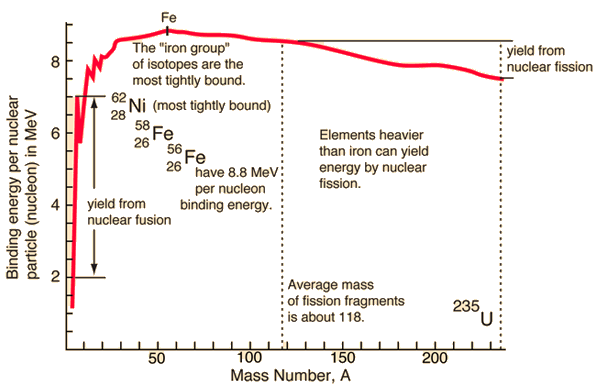
The 238U nucleus has a binding energy of about 7.6 MeV per nucleon. If the nucleus were to fission into two equal fragments, each would have a kinetic energy of just over 100 MeV. From this it can be concluded that

A. 238U cannot fission spontaneously
B. 238U has a large neutron excess
C. nuclei near A = 120 have masses greater than half that of 238U
D. nuclei near A = 120 must be bound by about 6.7 MeV/nucleon
E. nuclei near A = 120 must be bound by about 8.5 MeV/nucleon
(GR0177 #67)
Solution:

(A) FALSE.
238U is a heavy element, it can fission spontaneously.

(B) FALSE.
It is not related to binding energy

(C) FALSE.
Total mass of nucleus is always less than the sum of the masses of its individual nucleons.

(D) FALSE.
Nuclei near A = 120 must be bound by energy greater than A = 238 (must be more than 7.6 MeV per nucleon)

(E) TRUE.
8.5 MeV/nucleon is more than 7.6 MeV per nucleon.

Answer: E

Notes:

To calculate the binding energy per nucleon:

238U → A = 238 ≈ 240
238U nucleus were to fission into two equal fragments: A1 = A2 = A' = 240/2 = 120

Initial binding energy: Ei = 240 × 7.6 MeV

Final binding energy: Ef = 120 E + 120 E = 240 E 

The kinetic energy of the two fragments is the difference in binding energy between the initial and final state nuclei:


Thus, nuclei near A = 120 must be bound by about 8.5 MeV/nucleon

The graph also shows that for A = 120, binding energy is about 8.5 MeV/nucleon


Source: hyperphysics.phy-astr.gsu.edu

Thermal Physics - Pressure of photon gas

Compute the pressure exerted by gas of photons.

Solution:

According to kinetic theory analysis, pressure:


Momentum: p = mv
For photon, v = c
Energy of photon: E = pc

→ Pressure:


Ideal Gas: PV = NkT

→ Pressure:


→ Energy: 

Thermal Physics - Kinetic Theory Analysis

Using kinetic theory analysis, show that pressure of ideal gas is proportional to the average translational kinetic energy and number density. 


Solution:

Force:

Total Force:

n = Number of collision in time Δt
Number of particles that moves in one direction highly likely is half of total particle, n = ½ N

Density: N/V
Volume of container : V = vxtA


Δp = Momentum transferred to wall per elastic collision.
Ideal gas → elastic collision → particle moves in x-direction with velocity vx and bounces back with velocity −vx.


Force:


Pressure:


Average velocity, equal probability:


Pressure:


In terms of average kinetic energy and number density, pressure:


Pressure of ideal gas is proportional to the average translational kinetic energy and number density